
Introduction
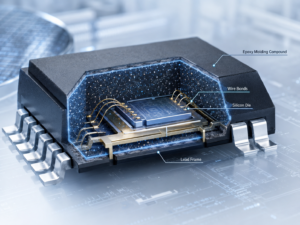
As semiconductor packages become smaller, denser, and more highly integrated, material purity becomes increasingly important to long-term device reliability.
Epoxy molding compounds (EMCs), liquid encapsulants, underfills, adhesives, and other polymeric packaging materials protect semiconductor devices from mechanical stress and environmental exposure. However, these materials can also contain trace ionic impurities originating from raw materials, synthesis residues, additives, fillers, processing steps, or external contamination.
Among these impurities, mobile ions such as chloride (Cl⁻), sodium (Na⁺), potassium (K⁺), and other ionic species can become problematic when moisture, electrical bias, and elevated temperature are present.
Research on microelectronic encapsulants has shown that epoxy molding compounds may contain ionic contaminants and that moisture absorbed by the polymer can create conditions in which ionic transport contributes to corrosion processes. Chloride ions are of particular concern because they can accelerate corrosion of aluminum metallization.
For semiconductor packaging formulators, controlling ionic contamination is therefore not simply a raw-material purity issue.
It is a package reliability issue.
One practical approach is the use of an ionic adsorbent, also commonly described in semiconductor materials literature as an ion trapping agent or ion scavenger.
These functional additives are designed to capture or immobilize mobile ionic impurities inside the encapsulation material before they can migrate toward sensitive interfaces.
This article explains how ion trapping agents work, why they are used in semiconductor packaging materials, and what formulators should consider when selecting an ionic adsorbent for epoxy molding compounds and advanced encapsulation systems.
Why Ionic Contamination Matters in Semiconductor Packaging?
Semiconductor packages operate with very small geometries and increasingly dense conductive structures.
Even trace contaminants can become important when several environmental conditions occur simultaneously.
Moisture, Ions and Electrical Bias
Epoxy molding compounds are not completely impermeable to moisture.
During high-humidity exposure, water molecules can diffuse into the polymer matrix. If mobile ionic impurities are also present, absorbed moisture can provide the medium needed for ionic transport.
When an electrical potential exists between nearby conductive structures, mobile ions may participate in electrochemical processes.
Research on electronic assemblies has shown that ionic contaminants can influence leakage current, electrochemical migration, dendrite growth, and corrosion behavior.
A simplified reliability pathway can be represented as:
Moisture ingress → dissolution or mobilization of ionic impurities → ion migration → electrochemical reaction → corrosion or electrical leakage → potential device failure
This does not mean that every trace ion automatically causes device failure.
Actual risk depends on many variables, including:
- ion concentration;
- ion mobility;
- moisture content;
- temperature;
- electrical bias;
- metallization type;
- package architecture;
- encapsulant chemistry;
- and exposure time.
The objective of ionic control is therefore to reduce the population and mobility of potentially harmful ionic species.
Common Ionic Contaminants in Packaging Materials
Several ionic species may be relevant to electronic packaging reliability.
Typical examples include:
| Ionic Species | Possible Source | Potential Reliability Concern |
|---|---|---|
| Chloride, Cl⁻ | Epoxy synthesis residues, raw materials, contamination | Metal corrosion and electrochemical processes |
| Sodium, Na⁺ | Fillers, process residues, raw materials | Mobile ionic contamination |
| Potassium, K⁺ | Raw materials or processing | Mobile ionic contamination |
| Sulfate, SO₄²⁻ | Chemical residues or raw materials | Ionic conductivity / corrosion concerns |
| Organic ionic residues | Additives, catalysts, processing residues | Conductivity and electrochemical effects |
Ion chromatography has long been used in electronics failure analysis because species including chloride, sulfate, sodium, and potassium are commonly associated with ionic contamination and corrosion investigations.
For packaging formulators, however, the relevant question is not simply:
“How many ions are present?”
A second question is equally important:
“How mobile are those ions under actual package operating conditions?”
Where Do Ionic Impurities Come From?
Ionic contamination can enter semiconductor packaging formulations through multiple pathways.
One important source is the resin itself.
Many epoxy resins are manufactured using epichlorohydrin-based chemistry. Trace chlorine-containing species may remain depending on resin chemistry and purification.
Fillers, pigments, curing agents, accelerators, flame-retardant systems, coupling agents, release agents, and other functional additives can also contribute trace ionic species.
In addition, contamination may be introduced through:
- raw-material handling;
- production equipment;
- water;
- storage conditions;
- formulation processing;
- or package assembly.
This is one reason advanced semiconductor encapsulant suppliers emphasize low ionic impurities as an important material characteristic. For example, current flip-chip liquid encapsulant materials are marketed with low ionic impurity levels alongside moisture resistance and electrical performance.
Reducing ions at the source should always be the first line of control.
But complete elimination is difficult.
This is where ionic adsorbents can provide an additional reliability strategy.
How Ionic Adsorbents Work in Semiconductor Encapsulants?
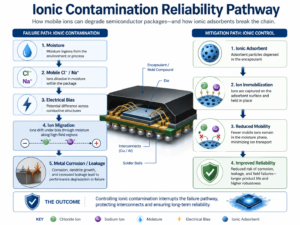
An ionic adsorbent does not necessarily remove ions from the formulation in the same way that purification removes contaminants from a liquid stream.
https://langyitechglobal.com/product/ionic-adsorbent/
Instead, it is incorporated into the polymer system and designed to capture, bind, exchange, or immobilize ionic species.
The objective is to reduce the concentration of freely mobile ions available for migration.
Modern semiconductor packaging formulations may use both anion trapping and cation trapping approaches, depending on the ionic species being controlled. Recent semiconductor encapsulation patent literature explicitly describes ion trapping systems for ionic impurities such as chloride and distinguishes between cation- and anion-trapping agents.
Anion Trapping
Anion-trapping materials can be designed to capture negatively charged species such as:
Cl⁻
Certain layered inorganic compounds and metal-based materials have been used for this purpose.
Hydrotalcite-type materials, for example, have a long history of use as ion trapping agents in semiconductor encapsulating materials.
Other inorganic systems described in semiconductor encapsulation literature include compounds based on:
- bismuth;
- zirconium;
- magnesium;
- aluminum;
- titanium;
- rare-earth oxides;
- and related inorganic structures.
Cation Trapping
Some packaging systems may also require control of positively charged mobile ions such as:
Na⁺ and K⁺
Different surface chemistries or ion-exchange structures may be required for cation adsorption.
This is why an ionic adsorbent should not be selected simply because it has a high general “ion adsorption” value.
Its selectivity toward the target ionic species is critical.
Immobilization Instead of Simple Removal
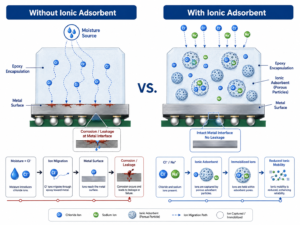
The practical purpose of an ionic adsorbent inside an EMC is to make harmful ions less mobile.
A simplified mechanism is:
Free mobile ion → interaction with ionic adsorbent → immobilized or strongly bound ion → reduced migration potential
This distinction matters because ion concentration measured after extraction may depend on both the total ionic content and how strongly those ions are retained inside the cured polymer.
https://langyitechglobal.com/electronics-electrical/
Ionic Adsorbent vs. Other Ionic-Contamination Control Strategies
No single strategy should be expected to solve every ionic reliability problem.
The best semiconductor encapsulation formulation usually combines multiple controls.
| Strategy | Main Function | Advantage | Limitation |
|---|---|---|---|
| High-purity raw materials | Reduce ions entering formulation | Controls contamination at source | Cannot always eliminate trace ions |
| Resin purification | Reduce residual ionic species | Improves base-resin purity | Adds cost and process complexity |
| Moisture-resistant resin design | Reduce water penetration | Reduces conditions supporting ion mobility | Does not directly capture existing ions |
| Ionic Adsorbent / Ion Trapping Agent | Immobilize mobile ionic species | Works inside final encapsulant | Must be compatible with formulation |
| Corrosion-control additives | Reduce corrosion reactions | Can improve metal protection | May not reduce ion mobility |
| Package barrier design | Reduce environmental ingress | Protects entire package | Dependent on architecture and processing |
The strongest reliability strategy is usually:
reduce ionic contamination at the source + limit moisture ingress + immobilize residual mobile ions + validate the complete package under reliability testing.
Applications in Epoxy Molding Compounds and Encapsulants
Ion trapping agents have been used in semiconductor epoxy encapsulation formulations for many years.
Patent literature covering semiconductor encapsulating epoxy compositions describes hydrotalcite-type compounds and other inorganic ion scavengers as additives for reducing the effects of ionic impurities.
Potential application areas include:
Epoxy Molding Compound — EMC
In conventional transfer-molded semiconductor packages, ionic adsorbents can be incorporated into the molding compound together with:
- epoxy resin;
- curing agent;
- silica filler;
- curing accelerator;
- coupling agent;
- release agent;
- pigment;
- and other functional additives.
Liquid Encapsulants
Advanced semiconductor packages may use liquid molding or encapsulation materials where low ionic contamination is also critical.
Underfill Materials
Flip-chip and advanced packaging architectures place polymeric materials close to fine-pitch electrical connections.
Current encapsulant products for flip-chip applications specifically emphasize low ionic impurities and migration resistance as important performance attributes.
Adhesives and Die-Attach Systems
Where electrically sensitive structures are surrounded by polymer adhesives, ionic mobility may also become part of the reliability evaluation.
Five Factors When Selecting an Ion Trapping Agent
1. Target Ion Selectivity
The first question should be:
Which ion needs to be controlled?
A material optimized for chloride adsorption may not provide the same performance for sodium or potassium.
Consider whether the formulation requires:
- primarily anion trapping;
- primarily cation trapping;
- or broader dual-ion management.
2. Adsorption Capacity Under Relevant Conditions
A high adsorption value measured in water does not automatically guarantee the same behavior inside a cured epoxy matrix.
Performance should be evaluated under conditions relevant to the intended formulation.
Important variables include:
- temperature;
- humidity;
- resin polarity;
- pH;
- degree of cure;
- and competing ionic species.
3. Particle Dispersion
Because ionic adsorbents are often inorganic particulate materials, dispersion quality can influence:
- viscosity;
- flow;
- filler packing;
- moldability;
- sedimentation;
- and local material uniformity.
For semiconductor packaging, particle characteristics must therefore be considered together with ionic functionality.
4. Compatibility with Other Additives
An ion trapping agent does not operate in isolation.
It exists alongside curing agents, accelerators, fillers, silanes, flame retardants, release agents and other additives.
This can create unexpected interactions.
For example, semiconductor encapsulation patent literature has reported interactions between certain hydrotalcite-type ion scavengers and release waxes, potentially contributing to mold sticking or package-surface contamination.
This is an important formulation lesson:
More ion trapping agent is not automatically better.
5. Long-Term Reliability
The final criterion is not simply initial ion adsorption.
The material must support performance after:
- high-temperature storage;
- high-temperature/high-humidity exposure;
- pressure-cooker or accelerated humidity testing;
- thermal cycling;
- reflow;
- and electrical bias.
The complete cured package—not only the additive—must be evaluated.
How to Evaluate Ionic Adsorbent Performance
A practical development program can compare a control formulation against several ionic-adsorbent loading levels.
Control Formulation
Encapsulant without ionic adsorbent.
Low Loading
Used to determine whether a small addition measurably reduces extractable or mobile ions without changing processing behavior.
Medium Loading
Used to identify the balance between ion trapping, rheology, cure behavior and package reliability.
Higher Loading
Used to identify whether additional ion trapping produces diminishing returns or negatively affects processing and other properties.
Recommended evaluation methods include:
| Test | Purpose |
|---|---|
| Ion Chromatography | Quantify extractable Cl⁻, Na⁺, K⁺ and other ions |
| Moisture Absorption | Evaluate water uptake |
| Electrical Leakage | Detect electrical reliability changes |
| High-Temperature / High-Humidity Testing | Accelerate moisture-related failure mechanisms |
| HAST / Pressure-Cooker-Type Testing | Evaluate severe humidity reliability |
| Metal Corrosion Evaluation | Examine metallization degradation |
| Rheology / Spiral Flow | Evaluate EMC processing behavior |
| Cure Characterization | Check effects on curing reaction |
| Mold Release Evaluation | Identify sticking or surface contamination |
| Package Cross-Section Analysis | Investigate interfaces and failure locations |
Ion chromatography is particularly useful because it allows individual ionic species to be quantified instead of relying only on total conductivity measurements.
Common Formulation Mistakes
Focusing Only on Total Ionic Content
Total ion concentration alone does not fully describe reliability risk.
Ion type, mobility, moisture, bias and package architecture also matter.
Evaluating Only the Additive in Water
An adsorbent may perform differently once incorporated into a highly filled epoxy system.
Testing should therefore progress from material screening to actual encapsulant formulations.
Ignoring Processability
An additive that reduces chloride concentration but causes poor mold flow, excessive viscosity, mold contamination or poor adhesion may not be commercially useful.
Assuming Higher Dosage Is Always Better
Excess additive can change the overall formulation balance.
Optimization should therefore be based on minimum effective loading, not maximum possible loading.
Conclusion
As semiconductor packages become smaller and more electrically demanding, controlling mobile ionic impurities becomes increasingly important for long-term material reliability.
Chloride, sodium, potassium and other ionic contaminants can originate from resin chemistry, fillers, additives and manufacturing processes.
When combined with absorbed moisture, elevated temperature and electrical bias, mobile ions can contribute to corrosion, leakage and electrochemical migration mechanisms.
An ionic adsorbent—or ion trapping agent—provides an additional control mechanism by capturing or immobilizing residual ionic species inside the encapsulation material.
However, successful implementation requires more than selecting a material with a high laboratory adsorption value.
Semiconductor packaging formulators should consider:
- target-ion selectivity;
- adsorption mechanism;
- particle characteristics;
- resin compatibility;
- processing behavior;
- additive interactions;
- extractable ion performance;
- and long-term package reliability.
The best solution is ultimately a system-level approach combining high-purity raw materials, low moisture uptake, effective ion trapping and package-level reliability validation.
Looking for an Ionic Adsorbent for Semiconductor Packaging?
Langyi provides ionic adsorbent solutions for applications where the control of mobile ionic impurities is important to material reliability.
For semiconductor packaging, epoxy molding compounds, encapsulation resins and other electronic-material systems, material selection should be based on the target ionic species, resin chemistry, processing conditions and reliability requirements.
If you are developing a semiconductor encapsulation formulation and need to evaluate ionic adsorption performance, contact Langyi’s technical team to discuss your target ions, resin system and application requirements or request samples for formulation testing.
Frequently Asked Questions
What is an ion trapping agent in semiconductor packaging?
An ion trapping agent is a functional additive incorporated into semiconductor encapsulation materials to capture or immobilize ionic impurities and reduce their mobility inside the polymer system.
Why are chloride ions important in semiconductor packaging?
Chloride ions can participate in corrosion and electrochemical processes, particularly when moisture and electrical bias are present. Research on epoxy encapsulants has specifically identified chloride as an important contaminant affecting aluminum metallization reliability.
What is the difference between an ionic adsorbent and an ion scavenger?
In semiconductor packaging literature, the terms ionic adsorbent, ion trapping agent, and ion scavenger are often used for materials designed to capture or immobilize ionic impurities. The exact mechanism depends on the material chemistry.
Can one ion trapping agent remove both anions and cations?
Not necessarily. Different adsorbent chemistries may have different selectivity toward anions and cations. The target ionic species should therefore be identified before selecting the additive.
Can an ionic adsorbent be used in epoxy molding compound?
Yes. Ion trapping agents have a long history of use in semiconductor epoxy molding and encapsulation formulations.
How should ionic contamination be measured?
Ion chromatography is commonly used to identify and quantify individual ionic species such as chloride, sodium, potassium and sulfate in electronics materials and failure analysis.
Does adding more ion trapping agent always improve reliability?
No. The optimum loading depends on adsorption efficiency and compatibility with the complete formulation. Excessive loading may affect rheology, molding behavior or interactions with other additives, so formulation testing is necessary.
External References
- Lantz, L. II & Pecht, M. G. Ion Transport in Encapsulants Used in Microcircuit Packaging. IEEE Transactions on Components and Packaging Technologies, Vol. 26, No. 1, 2003.
- Application of Ion Chromatography to Failure Analysis of Electronics Packaging. Journal of Chromatography A, Vol. 546, 1991, pp. 347–350.
- Harsányi, G. Irregular Effect of Chloride Impurities on Migration Failure Reliability. Microelectronics Reliability, Vol. 39, 1999.
- Verdingovas, V., Jellesen, M. S. & Ambat, R. Influence of Sodium Chloride and Weak Organic Acids on Electrochemical Migration of Tin on Surface Mount Chip Components. Corrosion Engineering, Science and Technology, 2013.
- Semiconductor Encapsulating Epoxy Resin Composition and Semiconductor Device. Technical patent literature describing hydrotalcite and other ion trapping systems for semiconductor encapsulation.
- Liquid Epoxy Resin Composition for Mold Underfill Material for TSV. Recent patent literature describing anion and cation trapping agents for ionic impurities including chloride.
- Resonac. Liquid Encapsulants for Flip Chip — CEL-C Series. Current commercial encapsulation materials emphasizing low ionic impurities and migration resistance.
**********************************************************************************
半導體封裝用離子吸附劑:如何控制環氧封裝材料中的離子雜質
前言
隨著半導體封裝持續朝向更小尺寸、更高整合度與更高導線密度發展,封裝材料中的離子純度對元件長期可靠性的影響也越來越重要。
環氧塑封料(Epoxy Molding Compound, EMC)、液態封裝材料、底部填充膠(Underfill)、黏著劑以及其他高分子封裝材料,主要用於保護半導體元件免受機械應力、濕氣及環境因素影響。
然而,這些材料本身也可能含有微量離子雜質,其來源可能包括:
- 樹脂原料
- 合成殘留物
- 無機填料
- 固化劑與促進劑
- 功能添加劑
- 生產製程
- 外部污染
其中,氯離子(Cl⁻)、鈉離子(Na⁺)、鉀離子(K⁺)以及其他可移動離子,在高溫、高濕及電場偏壓條件下,可能對半導體封裝可靠性造成潛在風險。
當水分進入封裝材料後,部分可移動離子可能在高分子體系中發生遷移,進一步參與金屬腐蝕、漏電流增加或電化學遷移等失效機制。
因此,對半導體封裝材料製造商而言,控制離子污染不只是原材料純度問題,更是一項重要的:
Package Reliability Issue —— 封裝可靠性問題。
其中一種有效的材料解決方案,是在封裝體系中加入離子吸附劑(Ionic Adsorbent)。
在半導體材料領域,這類材料也經常被稱為:
- Ion Trapping Agent
- Ion Scavenger
- Ion Capture Agent
- Ionic Adsorbent
其核心作用是捕捉、固定或降低封裝材料中可移動離子的活性,從而降低其向敏感界面或金屬結構遷移的可能性。
本文將介紹離子吸附劑在半導體封裝中的作用機理、主要應用、材料選型要點以及封裝配方開發過程中應重點關注的可靠性指標。
為什麼離子污染會影響半導體封裝可靠性?
現代半導體封裝中的導電線路尺寸越來越小,導線與電極之間的距離也持續縮短。
因此,即使只有微量離子污染,在特定環境條件下也可能對可靠性產生影響。
水分、離子與電場偏壓
環氧塑封料並不是完全阻水的材料。
在高濕環境下,水分可能逐漸擴散進入高分子封裝材料。
如果材料內部同時存在可移動離子,吸收的水分就可能成為離子移動的介質。
當相鄰導體之間存在電位差時,部分可移動離子可能參與:
- 電化學反應
- 金屬腐蝕
- 電化學遷移
- 漏電流增加
- 絕緣性能下降
其潛在失效路徑可以簡化為:
水分進入
↓
離子溶解或活化
↓
離子遷移
↓
電化學反應
↓
金屬腐蝕 / 漏電
↓
封裝可靠性下降
這並不代表任何微量離子的存在都一定會造成封裝失效。
實際風險還受到多個因素共同影響,包括:
- 離子濃度
- 離子移動性
- 水分含量
- 工作溫度
- 電場強度
- 金屬化材料
- 封裝結構
- 樹脂化學體系
- 使用時間
因此,離子控制的核心目標,是:
降低潛在有害離子的自由濃度與移動能力。
半導體封裝材料中常見的離子污染物
在電子封裝材料中,較常受到關注的離子包括:
| 離子種類 | 可能來源 | 潛在可靠性風險 |
|---|---|---|
| Cl⁻ 氯離子 | 樹脂合成殘留、原料或製程污染 | 金屬腐蝕、電化學反應 |
| Na⁺ 鈉離子 | 填料、製程或原材料 | 可移動離子污染 |
| K⁺ 鉀離子 | 原材料或加工過程 | 離子遷移與電氣性能變化 |
| SO₄²⁻ 硫酸根 | 化學殘留或原材料 | 離子導電與腐蝕風險 |
| 有機離子殘留 | 添加劑、催化劑或合成殘留 | 電導率與電化學效應 |
對半導體封裝配方設計而言,不能只問:
「材料裡有多少離子?」
另一個同樣重要的問題是:
「這些離子在高溫、高濕及電場條件下是否容易移動?」
因為真正影響封裝可靠性的,往往不只是總離子含量,而是:
Mobile Ionic Species —— 可移動離子。
離子雜質從哪裡來?
半導體封裝材料中的離子污染可能來自多個環節。
環氧樹脂
部分環氧樹脂的製造過程涉及含氯化學原料。
根據樹脂種類、合成方式與純化程度不同,可能殘留微量含氯物質。
因此,對高可靠性電子封裝而言,低氯環氧樹脂及低離子純度控制非常重要。
無機填料
二氧化矽等填料如果原料純度或表面處理控制不足,也可能帶入:
- Na⁺
- K⁺
- Cl⁻
- 其他可溶性離子
固化劑與促進劑
部分固化劑、催化劑與促進劑本身也可能帶入離子型殘留物。
其他添加劑
例如:
- 阻燃劑
- 偶聯劑
- 脫模劑
- 顏料
- 表面改性劑
都有可能成為微量離子來源。
此外,污染也可能來自:
- 生產設備
- 製程用水
- 物料儲存
- 原料運輸
- 配方製備
- 封裝組裝
因此,在半導體封裝材料設計中,首先應盡可能從源頭降低離子污染。
但要完全消除所有離子通常並不容易。
這正是離子吸附劑可以發揮作用的地方。
離子吸附劑如何在半導體封裝材料中工作?
離子吸附劑並不像水處理中的過濾材料一樣,直接將離子從系統中移除。
在半導體封裝材料中,它通常被直接加入環氧樹脂或封裝材料體系中。
其主要作用是:
捕捉、吸附、交換或固定可移動離子。
目的是降低離子在封裝材料內的自由移動能力。
其作用機理可以簡化為:
Free Mobile Ion
↓
Interaction with Ionic Adsorbent
↓
Captured / Immobilized Ion
↓
Reduced Ionic Mobility
也就是:
自由離子 → 與離子吸附劑作用 → 被固定 → 移動性降低。
陰離子吸附
部分離子吸附劑主要用於捕捉負電荷離子。
例如:
Cl⁻
氯離子是半導體封裝材料中較受關注的污染物之一。
某些層狀無機材料、金屬氧化物及特定離子交換材料,可以透過表面作用或離子交換方式固定氯離子。
在半導體環氧封裝材料中,水滑石類(Hydrotalcite-Type)材料就長期被用作離子捕捉材料之一。
其他可用於離子管理的無機體系可能包括:
- 鉍系材料
- 鋯系材料
- 鎂系材料
- 鋁系材料
- 鈦系材料
- 稀土氧化物
- 複合無機離子吸附材料
陽離子吸附
部分電子封裝材料還需要控制:
- Na⁺
- K⁺
等正電荷可移動離子。
陽離子與陰離子的捕捉機理不同,因此不一定可以使用同一種材料完成所有離子控制。
也就是說:
一款對 Cl⁻ 吸附能力很高的材料,不一定同樣適合 Na⁺ 或 K⁺。
因此,在選擇離子吸附劑之前,首先需要明確:
目標離子是什麼?
離子固定比單純「去除離子」更重要
在半導體環氧封裝材料中,實際目標並不一定是讓總離子含量變成零。
更實際的目標是:
降低自由離子與可移動離子的比例。
因為即使某些離子仍然存在,如果被穩定固定在無機吸附劑表面或晶體結構中,其在高濕與電場條件下的遷移能力就可能降低。
因此,對封裝可靠性而言:
Ion Mobility
往往比單純的:
Total Ion Concentration
更加重要。
離子吸附劑與其他離子污染控制方式比較
半導體封裝材料的離子控制通常不應只依賴單一技術。
更有效的方法通常是多種措施共同作用。
| 控制策略 | 主要作用 | 優勢 | 主要限制 |
|---|---|---|---|
| 高純度原材料 | 從源頭降低離子含量 | 最直接有效 | 無法完全消除微量污染 |
| 樹脂純化 | 降低樹脂殘留離子 | 提升基礎樹脂純度 | 增加成本與製程 |
| 低吸濕樹脂設計 | 降低水分進入 | 減少離子遷移條件 | 無法直接捕捉已有離子 |
| 離子吸附劑 | 固定可移動離子 | 可在最終材料中持續作用 | 需要良好配方相容性 |
| 防腐蝕添加劑 | 降低腐蝕反應 | 可提升金屬保護 | 不一定降低離子移動 |
| 封裝阻隔設計 | 降低濕氣進入 | 系統級保護 | 受封裝結構限制 |
因此,較完整的封裝可靠性策略通常是:
高純度原材料
+
低吸濕材料設計
+
離子固定
+
封裝級可靠性驗證
離子吸附劑在環氧塑封料中的應用
離子捕捉材料在半導體環氧封裝領域已有長期應用。
Epoxy Molding Compound — EMC
在傳統半導體環氧塑封料中,離子吸附劑可以與以下材料共同加入配方:
- Epoxy Resin
- Curing Agent
- Silica Filler
- Curing Accelerator
- Coupling Agent
- Release Agent
- Pigment
- 其他功能添加劑
其主要作用是降低封裝材料中的自由離子與離子移動性。
液態封裝材料
先進封裝中也大量使用液態封裝材料。
例如:
- Liquid Mold Compound
- Liquid Encapsulant
- Wafer-Level Encapsulation Materials
這些材料通常對:
- 低離子雜質
- 低吸濕
- 高絕緣
- 低離子遷移
具有較高要求。
Underfill 底部填充材料
在 Flip-Chip 與先進封裝中,Underfill 會直接填充在晶片與基板之間。
由於材料非常靠近細間距導電結構,因此離子純度尤其重要。
這類應用往往需要同時考慮:
- 低 Cl⁻
- 低 Na⁺ / K⁺
- 低吸濕率
- 高絕緣性能
- 高耐熱性
- 低離子移動性
黏著劑與 Die-Attach 材料
在 Die Attach Adhesive、封裝膠及其他高可靠性電子黏著材料中,也可能需要控制離子雜質。
尤其是在聚合物材料直接接近金屬電極與微細導線的情況下,離子移動性值得重點評估。
選擇離子吸附劑時需要考慮的五個因素
1. 目標離子選擇性
首先要確認:
需要吸附的是哪一種離子?
例如:
- Cl⁻
- Na⁺
- K⁺
- SO₄²⁻
- 其他離子
不同材料對不同離子的吸附能力可能存在明顯差異。
因此,需要確認配方主要需要:
- 陰離子捕捉
- 陽離子捕捉
- 或同時進行陽 / 陰離子管理
2. 實際封裝條件下的吸附能力
某種離子吸附劑在水溶液中的吸附性能很好,並不代表其在固化環氧樹脂中也一定具有相同效果。
實際性能可能受到以下條件影響:
- 溫度
- 濕度
- 樹脂極性
- pH
- 固化程度
- 競爭離子
- 添加量
因此,材料測試必須逐步從:
水溶液測試
轉向:
實際封裝配方測試。
3. 粒子分散性能
離子吸附劑通常屬於無機微粒或奈米材料。
因此,其粒徑與分散性能可能直接影響:
- 黏度
- 流動性
- 填料堆積
- 成型性能
- 沉降
- 配方均勻性
對 EMC 而言,這些性能會進一步影響:
Moldability —— 塑封加工性能。
4. 與其他添加劑的相容性
離子吸附劑不是單獨存在的。
在實際環氧封裝配方中,它需要與:
- 固化劑
- 促進劑
- 矽微粉
- 偶聯劑
- 阻燃劑
- 脫模劑
- 顏料
共同作用。
因此,需要特別注意添加劑之間的相互影響。
例如,部分離子捕捉材料如果與脫模劑相容性不足,可能影響:
- 模具脫模
- 表面污染
- 模具沾黏
- 封裝外觀
因此:
離子吸附劑並不是添加越多越好。
更合理的策略是找到:
Minimum Effective Loading —— 最低有效添加量。
5. 長期可靠性
評估離子吸附劑時,不能只看初始離子吸附數據。
還需要確認最終封裝材料經歷以下條件後的性能:
- 高溫儲存
- 高溫高濕
- HAST
- Pressure Cooker Test
- Thermal Cycling
- Reflow
- Electrical Bias
最終需要評估的是:
完整封裝系統的可靠性。
如何評估離子吸附劑性能?
建議使用不同添加量進行配方梯度測試。
Control Formulation — 對照配方
不添加離子吸附劑。
建立原始封裝材料的基準數據。
Low Loading — 低添加量
觀察:
- 可萃取離子是否下降
- 黏度是否變化
- 加工性是否受到影響
Medium Loading — 中等添加量
尋找:
離子捕捉能力、流變性能、固化性能與可靠性之間的最佳平衡。
Higher Loading — 高添加量
觀察是否出現:
- 邊際吸附效益下降
- 黏度過高
- 流動性下降
- 填料體系失衡
- Mold Release 問題
- 配方相容性下降
建議測試項目
| 測試項目 | 測試目的 |
|---|---|
| Ion Chromatography | 測量 Cl⁻、Na⁺、K⁺ 等可萃取離子 |
| Moisture Absorption | 評估吸濕性能 |
| Electrical Leakage | 評估電氣絕緣可靠性 |
| High Temperature / High Humidity | 評估高溫高濕可靠性 |
| HAST | 加速濕熱可靠性測試 |
| Pressure Cooker Test | 評估高壓高濕條件 |
| Metal Corrosion Evaluation | 評估金屬腐蝕 |
| Rheology / Spiral Flow | 評估 EMC 加工流動性 |
| Cure Characterization | 評估對固化反應的影響 |
| Mold Release Evaluation | 評估模具脫模性能 |
| Package Cross-Section | 分析界面與失效位置 |
其中:
Ion Chromatography(離子色譜)
是半導體封裝材料離子污染分析中非常重要的工具。
它可以分別檢測:
- Cl⁻
- Na⁺
- K⁺
- SO₄²⁻
等不同離子,而不是只測量總導電度。
常見配方錯誤
只關注總離子含量
總離子含量並不能完全代表可靠性風險。
更重要的是:
- 離子種類
- 離子移動性
- 水分
- 電場
- 封裝結構
只在水溶液中測試吸附能力
某款離子吸附劑在純水中的性能很好,不代表其在高填充環氧樹脂中一定有相同性能。
因此,測試應逐步進入實際配方。
忽略加工性能
如果一種材料能降低 Cl⁻,但同時造成:
- 黏度上升
- Mold Flow 下降
- 模具污染
- 脫模困難
- 附著性能下降
那麼它的商業應用價值就會受到限制。
認為添加量越高越好
過高的離子吸附劑添加量可能改變整個封裝材料體系的平衡。
因此,應以:
有效控制離子 + 不破壞加工與可靠性
作為優化目標。
結論
隨著半導體封裝結構越來越微型化與高密度化,可移動離子污染對長期封裝可靠性的影響也變得更加重要。
Cl⁻、Na⁺、K⁺ 以及其他離子可能來自:
- 樹脂
- 無機填料
- 添加劑
- 生產製程
- 外部污染
當這些可移動離子與水分、高溫及電場同時存在時,可能增加:
- 金屬腐蝕
- 漏電
- 電化學遷移
- 絕緣失效
等可靠性風險。
離子吸附劑(Ionic Adsorbent / Ion Trapping Agent)可以透過捕捉或固定殘留離子,降低其在封裝材料中的移動能力。
但成功應用離子吸附劑不能只看單一吸附數據。
半導體封裝材料製造商還需要綜合考慮:
- 目標離子選擇性
- 吸附機理
- 粒徑
- 分散性
- 樹脂相容性
- 加工性能
- 添加劑相互作用
- 可萃取離子
- 長期封裝可靠性
因此,更理想的半導體離子控制策略應該是:
高純度原材料 + 低吸濕設計 + 有效離子固定 + 封裝級可靠性驗證。
正在尋找半導體封裝用離子吸附劑?
Langyi 提供適用於高可靠性材料體系的離子吸附解決方案。
如果您正在開發:
- Semiconductor Packaging Materials
- Epoxy Molding Compound
- Liquid Encapsulant
- Underfill
- Electronic Adhesive
- High-Purity Epoxy Systems
並需要降低材料中的可移動離子,我們的技術團隊可以根據:
- 目標離子種類
- 樹脂體系
- 加工條件
- 添加方式
- 封裝可靠性要求
協助進行材料選型與配方評估。
歡迎聯繫 Langyi 技術團隊,討論您的半導體封裝材料需求,或申請離子吸附劑樣品進行配方測試。
常見問題 FAQ
半導體封裝中的 Ion Trapping Agent 是什麼?
Ion Trapping Agent 是一種加入半導體封裝材料中的功能性添加劑。
其主要作用是捕捉、固定或降低離子雜質在高分子材料中的移動能力。
中文通常可以稱為:
- 離子吸附劑
- 離子捕捉劑
- 離子固定劑
為什麼氯離子對半導體封裝很重要?
氯離子在存在水分與電場偏壓的條件下,可能參與金屬腐蝕與其他電化學反應。
因此,Cl⁻ 通常是高可靠性半導體封裝材料重點控制的離子之一。
Ionic Adsorbent 和 Ion Scavenger 有什麼不同?
在半導體封裝材料領域:
Ionic Adsorbent
Ion Trapping Agent
Ion Scavenger
這些詞經常被用來描述具有離子捕捉或離子固定能力的功能材料。
實際作用機理則會根據材料化學組成不同而有所差異。
一種離子吸附劑可以同時吸附陰離子和陽離子嗎?
不一定。
不同材料可能對不同離子具有不同選擇性。
例如,一種材料可能更適合捕捉 Cl⁻,另一種材料則可能更適合 Na⁺ 或 K⁺。
因此,需要先明確目標離子。
離子吸附劑可以加入 Epoxy Molding Compound 嗎?
可以。
離子捕捉材料長期以來一直被應用於半導體環氧封裝材料中。
但需要同時評估:
- 樹脂相容性
- 添加量
- 粒徑
- 流動性
- 固化行為
- 脫模性能
- 長期可靠性
如何測量半導體封裝材料中的離子污染?
離子色譜(Ion Chromatography)是常用方法之一。
可用於分別測量:
- Cl⁻
- Na⁺
- K⁺
- SO₄²⁻
等離子種類。
離子吸附劑添加越多,封裝可靠性就越高嗎?
不一定。
過高的添加量可能影響:
- 黏度
- Mold Flow
- 固化
- 填料分布
- 脫模性能
- 其他添加劑相容性
因此,更合理的方法是找出:
最低有效添加量與最佳可靠性平衡。