
Introduction
Polyethylene terephthalate (PET) film is widely used in automotive window films, architectural films, optical films, protective laminates, and other functional film applications because of its excellent mechanical strength, dimensional stability, transparency, and processability.
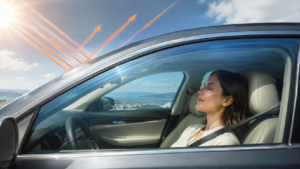
However, when PET film is used in applications exposed to sunlight—particularly automotive glazing—controlling solar heat becomes an important technical challenge.
A transparent film must allow sufficient visible light to pass through while reducing the amount of solar energy entering the vehicle or building. Simply making the film darker is not always an effective solution because visible-light absorption and infrared heat management are two different issues.
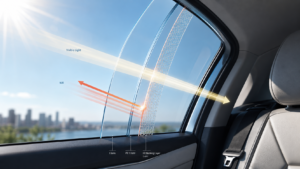
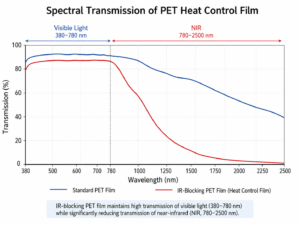
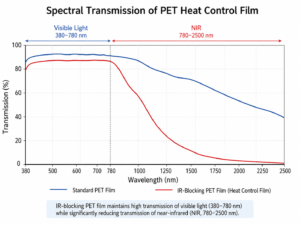
One increasingly important approach is to introduce infrared blocking technology into PET film systems, allowing manufacturers to selectively reduce near-infrared transmission while maintaining acceptable visible light transmission and optical clarity.
This article explains how to reduce heat in PET film, the technologies available, and the most important formulation parameters that automotive window film and PET film manufacturers should evaluate.
Why Does PET Film Become Hot Under Solar Radiation?
Solar radiation reaching a window contains ultraviolet, visible, and infrared wavelengths.
For a transparent automotive window film, the technical challenge is not simply to block sunlight. The film must selectively manage solar energy while maintaining visibility.
Near-infrared radiation is therefore an important part of heat-control film design. In commercial automotive window-film testing, infrared performance may be evaluated across different wavelength ranges. For example, IRR may refer to a narrower infrared range, while IRER can evaluate energy across approximately 780–2500 nm and account more broadly for transmitted and absorbed infrared energy. tinction matters.
A film showing a very high rejection value at only one wavelength does not necessarily provide equally strong heat rejection across the entire solar infrared spectrum.
For manufacturers, the objective should therefore be to develop a PET film with a balanced combination of:
- low infrared transmission;
- high or controlled visible light transmission;
- low haze;
- suitable color neutrality;
- good weather resistance;
- stable adhesion and coating performance;
- and high total solar energy rejection.
How Infrared Blocking Technology Reduces Heat in PET Film?
https://langyitechglobal.com/product/infrared-blocking-agent/
Near-Infrared Management
Infrared blocking agents are functional materials designed to interact strongly with near-infrared radiation.
Depending on the chemistry and particle structure, the material may absorb, reflect, or otherwise attenuate NIR radiation before it passes through the PET film system.
Transparent heat-shielding research frequently focuses on materials capable of providing strong NIR attenuation without causing excessive loss of visible transparency. Cesium tungsten bronze and related tungsten-based materials, for example, have received considerable research attention because of their strong near-infrared absorption combined with useful visible-light transmission. perly dispersed in a coating, adhesive, or polymer system, these functional particles can significantly change the spectral transmission profile of the final film.
Instead of reducing all wavelengths equally, an optimized formulation preferentially reduces infrared transmission while allowing a greater proportion of visible light to remain.
Balancing Heat Rejection and Visible Light Transmission
This balance is one of the most important formulation challenges in automotive window film.
Increasing the concentration of an infrared blocking agent can improve NIR attenuation, but excessive loading may also lead to:
- lower visible light transmission;
- increased haze;
- color changes;
- particle agglomeration;
- reduced coating uniformity;
- or changes in mechanical properties.
For this reason, the best formulation is rarely the formulation with the highest possible concentration of infrared absorber.
The target is optical selectivity: achieving maximum practical infrared attenuation with minimum impact on the visible region.
Main Technologies for Reducing Heat in PET Film
PET window-film manufacturers can use several approaches to improve heat rejection.
1. Dyed or Tinted Films
Colorants reduce the overall amount of transmitted light.
They are relatively straightforward to formulate but tend to reduce visible light together with solar energy. As a result, darker appearance does not necessarily indicate superior infrared performance.
2. Metallized Films
Thin metallic layers can reflect part of the incoming solar radiation and provide effective heat rejection.
However, metallic layers may affect radio-frequency signals, GPS, mobile communications, or other electronic systems depending on the film structure.
3. Conductive Oxide Nanoparticles
Materials such as antimony-doped tin oxide (ATO) and indium tin oxide (ITO) can provide infrared attenuation while maintaining useful transparency.
Their performance depends strongly on particle size, concentration, dispersion, coating thickness, and spectral requirements.
4. Tungsten-Based Infrared Blocking Materials
Tungsten oxide and tungsten bronze materials are another important class of transparent NIR shielding materials.
Research has demonstrated that the optical properties of these materials can be engineered to provide significant NIR shielding while retaining visible-light transmission. ultilayer Optical Structures
Instead of relying primarily on absorbing particles, carefully designed multilayer films can control selected wavelengths through optical interference.
This approach can provide excellent performance but normally requires more complex film architecture and manufacturing technology.
Comparing Heat-Control Technologies for PET Film
| Technology | Heat-Control Mechanism | Visible Clarity | Main Advantage | Key Consideration |
|---|---|---|---|---|
| Dyed Film | Broad light absorption | Medium | Simple processing | May require darker appearance |
| Metallized Film | Solar reflection | High | Strong heat rejection | Potential signal interference |
| ATO / ITO | NIR absorption/reflection | High | Established nano-oxide technology | Dispersion and formulation optimization |
| Tungsten-Based IR Blocking Agent | Strong selective NIR attenuation | High when optimized | High optical selectivity potential | Particle dispersion and dosage are critical |
| Multilayer Optical Film | Optical interference | Very high | Excellent optical control | Complex manufacturing |
No single technology is ideal for every PET film application.
The optimal solution depends on the required combination of VLT, heat rejection, color, haze, cost, manufacturing process, and durability.
Key Performance Indicators for Heat-Rejection PET Film
A common mistake during product development is to evaluate only one infrared rejection number.
For a technically meaningful comparison, several parameters should be considered together.
NIR / IRER
Near-infrared transmission or infrared energy rejection indicates how effectively the film manages infrared wavelengths.
A full spectral curve is usually more informative than a single-point measurement.
Total Solar Energy Rejection — TSER
TSER describes the proportion of total solar energy rejected by the filmed glazing system.
For real heat-control performance, TSER is generally more meaningful than looking only at a peak IR rejection percentage.
Visible Light Transmission — VLT
VLT measures how much visible light passes through the film.
Automotive applications often require carefully controlled VLT because local regulations and customer requirements may restrict how dark a window film can be.
Haze
Haze is especially important for high-transparency PET film.
Nanoparticle agglomeration, incompatible binders, poor wetting, or inappropriate particle size distribution can increase light scattering and reduce optical clarity.
Therefore, improving infrared rejection should never be evaluated independently from haze.
How to Incorporate Infrared Blocking Agents into PET Film Systems
There are several practical routes for introducing infrared blocking functionality.
Functional Coating
An infrared blocking agent can be dispersed into a suitable resin system and coated onto the PET substrate.
This approach allows manufacturers to adjust:
- coating thickness;
- particle concentration;
- binder chemistry;
- curing conditions;
- and surface properties.
It is particularly suitable when the infrared functionality needs to be concentrated within a defined functional layer.
Adhesive Layer
In multilayer automotive window films, the infrared blocking component may also be incorporated into an adhesive or intermediate functional layer.
The compatibility between the infrared absorber, adhesive chemistry, and PET surface becomes particularly important.
Technical prior art has demonstrated the use of tungsten-containing particles in PET-based NIR shielding structures and in functional layers used with polyester substrates. erbatch or Polymer Incorporation
Another option is to introduce the functional material directly into a polymer processing route.
A masterbatch approach may simplify dosing and handling during manufacturing, although the infrared material must remain sufficiently dispersed during melt processing.
Thermal stability is especially important because PET processing involves relatively high temperatures.
Five Formulation Factors That Affect Heat-Rejection Performance
1. Particle Dispersion
Dispersion is one of the most important variables.
Even an excellent infrared blocking material may produce poor optical performance if particles agglomerate.
Agglomeration can increase haze, reduce transparency, create coating defects, and cause inconsistent spectral performance.
2. Particle Size and Distribution
For transparent optical systems, particle characteristics strongly influence scattering.
Controlled nanoscale dispersion generally provides a better route toward combining optical clarity with infrared attenuation.
3. Infrared Blocking Agent Concentration
Higher dosage usually increases infrared attenuation, but the relationship is not unlimited.
Beyond the optimum concentration, additional loading may cause significant loss of visible transmission or higher haze without providing proportional improvement in useful solar performance.
A dosage ladder should therefore be tested during development.
4. Resin and Binder Compatibility
Surface chemistry influences whether particles remain uniformly dispersed inside a coating or adhesive.
Manufacturers should evaluate:
- wetting;
- sedimentation;
- viscosity stability;
- resin compatibility;
- coating appearance;
- and long-term storage stability.
5. Weather and Thermal Stability
Automotive films experience sunlight, heat, humidity, and repeated thermal cycling.
Therefore, initial optical performance is not enough.
An optimized PET heat-control film should maintain low haze, controlled color, adhesion, and infrared performance after accelerated aging.
Research and patent literature on NIR shielding films also emphasizes maintaining optical performance after heat, humidity, and weathering exposure. o Evaluate an Infrared Blocking PET Film
A practical development program should compare several experimental formulations rather than testing a single dosage.
For example:
Control Film
PET system without infrared blocking agent.
Low Loading
Used to evaluate optical clarity and initial infrared improvement.
Medium Loading
Used to identify the best balance between VLT and NIR attenuation.
High Loading
Used to determine when haze, color, or transmission begins to deteriorate.
Recommended evaluation parameters include:
| Test | Purpose |
|---|---|
| UV-Vis-NIR Spectroscopy | Measure spectral transmission |
| VLT | Evaluate visible transparency |
| NIR Transmission / IRER | Evaluate infrared control |
| TSER | Evaluate total solar performance |
| Haze | Measure optical clarity |
| Color Lab* | Evaluate color shift |
| Adhesion Test | Verify coating/laminate integrity |
| Accelerated Weathering | Assess long-term stability |
| High-Temperature / Humidity Test | Evaluate environmental durability |
For automotive window-film development, this data should ideally be measured both on the film itself and on the final film + glass system, because real application performance depends on the complete glazing structure.
Applications in Automotive Window Film
https://langyitechglobal.com/automotive-transportation/
Automotive glazing is an excellent example of why selective infrared management is valuable.
The market increasingly demands films that provide thermal comfort without requiring extremely dark tint levels.
Commercial automotive films already demonstrate that high heat rejection can be achieved using advanced ceramic, nano-scale, or multilayer optical technologies while maintaining different levels of visible transmission. window-film manufacturers, infrared blocking agents can therefore support the development of products targeting:
- automotive side-window film;
- automotive windshield-compatible film systems;
- sunroof films;
- high-VLT heat rejection films;
- architectural window films;
- transparent solar-control laminates;
- and other functional PET optical films.
The key is not simply to “block more infrared,” but to optimize the complete optical and thermal performance of the film.
Choosing the Right Infrared Blocking Solution
When selecting an infrared blocking agent for PET film, manufacturers should discuss more than the material’s headline IR rejection value.
Useful questions include:
- What wavelength range does the material absorb most strongly?
- What is the target visible light transmission?
- What haze level can the application tolerate?
- Is the product used in a coating, adhesive, or polymer matrix?
- What processing temperature will the material experience?
- What color or optical neutrality is required?
- What is the required weathering lifetime?
- What particle dispersion system is available?
- What is the target TSER of the finished film-on-glass construction?
Answering these questions makes it much easier to identify the appropriate infrared blocking technology and formulation route.
Conclusion
Reducing heat in PET film requires more than darkening the film or maximizing a single infrared rejection number.
For automotive and high-performance window-film applications, the most effective strategy is to manage near-infrared radiation selectively while preserving visible transparency, low haze, acceptable color, and long-term durability.
Infrared blocking agents provide a practical route for developing transparent heat-control PET films, but their performance depends heavily on particle dispersion, concentration, resin compatibility, coating design, and final film architecture.
The best formulation should therefore be selected based on spectral performance, VLT, haze, TSER, processing stability, and durability as a complete system.
Looking for an Infrared Blocking Solution for PET Film?
Langyi provides infrared blocking solutions for functional film and polymer applications.
If you are developing automotive window film, PET heat-control film, architectural film, or other transparent NIR-shielding products, our technical team can support material selection and sample evaluation based on your target VLT, NIR performance, processing route, and optical requirements.
Contact Langyi to discuss your PET film formulation or request samples for evaluation.
Frequently Asked Questions
What is the best way to reduce heat in PET film?
https://langyitechglobal.com/polymers-films-coatings/
For transparent PET films, selectively reducing near-infrared transmission with an infrared blocking material is one practical approach. The formulation should be optimized together with VLT, haze, TSER, and durability.
Can infrared blocking agents maintain PET film transparency?
Yes, depending on the infrared blocking technology, particle characteristics, concentration, and dispersion quality. Excessive dosage or poor dispersion can reduce transparency and increase haze.
What is the difference between IR rejection and TSER?
IR rejection evaluates infrared performance over a defined wavelength range. TSER evaluates the proportion of total solar energy rejected by the complete filmed glazing system. For thermal-performance comparison, both should be considered.
Does darker window film always reject more heat?
No. Darkness mainly relates to visible-light transmission. Advanced infrared-selective films may provide strong heat rejection while maintaining relatively high visible-light transmission.
What causes haze after adding an infrared blocking agent?
Common causes include particle agglomeration, poor resin compatibility, inappropriate particle size distribution, excessive dosage, or unstable dispersion.
Can infrared blocking agents be used in automotive PET window film?
Yes. Infrared blocking materials can be incorporated into coatings, adhesives, functional layers, or polymer systems depending on the film design and processing requirements.
External References
- Chao, L. et al. Transparent Heat Shielding Properties of Core-Shell Structured Nanocrystalline CsxWO3@TiO2. Nanomaterials, 2022, 12, 2806. DOI: 10.3390/nano12162806. hly Transparent and Thermally Stable Near-Infrared Shielding Films.** Journal of the Taiwan Institute of Chemical Engineers, 2022, 139, 104505. DOI: 10.1016/j.jtice.2022.104505. gsten Bronze CsxWO3 Nanopowders Doped by Ti to Enhance Transparent Thermal Insulation Ability for Energy Saving.** Journal of Alloys and Compounds, 2023, 944, 169164. DOI: 10.1016/j.jallcom.2023.169164. , M. et al. Thermal Plasma Synthesis of Tungsten Bronze Nanoparticles for Near Infra-Red Absorption Applications. Journal of Materials Chemistry, 2010. r-Infrared Ray Shielding Film, a Method Thereof, and a Composition Thereof.** Patent US20150362627A1. tomotive Window Film technical information — definitions of TSER, VLT, IRR
***************************************
前言
聚對苯二甲酸乙二醇酯(PET)薄膜憑藉優異的機械強度、尺寸穩定性、透明度及加工性能,被廣泛應用於汽車窗膜、建築膜、光學膜、保護膜以及其他功能性薄膜領域。
然而,當 PET 薄膜被應用於長時間暴露在太陽光下的場景,尤其是汽車玻璃與建築玻璃時,如何有效控制太陽熱能便成為一項重要的技術挑戰。
高性能透明薄膜需要在保持足夠可見光透過率的同時,降低進入車內或建築內部的太陽能量。單純讓薄膜顏色變深並不能真正解決隔熱問題,因為可見光吸收與紅外熱管理本質上是兩種不同的光學機制。
目前越來越重要的一種解決方案,是在 PET 薄膜體系中加入紅外阻隔技術,使薄膜能夠選擇性降低近紅外光透過,同時保持較高的可見光透過率與光學清晰度。
本文將從技術角度介紹如何降低 PET 薄膜的熱負荷、目前常見的紅外阻隔技術,以及汽車窗膜與 PET 功能膜製造商在配方開發過程中應重點關注的關鍵參數。
為什麼 PET 薄膜在太陽照射下會產生熱量?
照射到玻璃與薄膜表面的太陽光包含紫外線、可見光以及紅外線等不同波段。
對透明汽車窗膜而言,技術目標並不是單純阻擋太陽光,而是在保持良好視野與透明度的同時,對不同波段的太陽能量進行選擇性管理。
因此,近紅外光管理是隔熱膜設計中的重要環節。在商業汽車窗膜測試中,紅外性能可能會根據不同波長範圍進行測量。
例如,IRR 通常可能代表某一較窄波段下的紅外阻隔率,而 IRER 則可以在約 780–2500 nm 的更寬紅外波段內評估紅外能量阻隔效果。
因此,某款薄膜在單一波長上具有很高的紅外阻隔率,並不代表其在整個近紅外區域都具有同等優異的隔熱性能。
對薄膜製造商而言,更合理的開發目標應是取得以下性能之間的平衡:
- 低紅外透過率
- 較高或可控制的可見光透過率
- 低霧度
- 良好的色彩中性
- 良好的耐候性
- 穩定的塗層附著與加工性能
- 較高的總太陽能阻隔率
紅外阻隔技術如何降低 PET 薄膜熱量?
近紅外光管理
紅外阻隔劑是一類能夠與近紅外光產生強烈相互作用的功能性材料。
根據材料的化學組成及粒子結構不同,其可以通過吸收、反射或其他光學機制削弱近紅外能量,從而降低穿過 PET 薄膜系統的熱能。
透明隔熱技術通常會使用奈米級功能材料,使其在有效降低近紅外透過的同時,不會過度犧牲可見光透明度。
當這些功能粒子被均勻分散於塗層、膠黏劑或高分子體系中時,可以顯著改變最終薄膜的光譜透過特性。
理想的配方並不是對所有波長都進行同等阻隔,而是優先降低紅外區域的透過率,同時盡可能保留可見光透過。
隔熱性能與可見光透過率之間的平衡
這種性能平衡是汽車窗膜配方開發中最關鍵的技術問題之一。
提高紅外阻隔劑添加量通常可以增強近紅外阻隔能力,但添加量過高也可能造成:
- 可見光透過率下降
- 霧度上升
- 顏色偏移
- 粒子團聚
- 塗層均勻性下降
- 薄膜機械性能發生變化
因此,最好的配方通常並不是紅外阻隔劑添加量最高的配方。
真正的目標是提升「光譜選擇性」——在最大程度削弱紅外能量的同時,盡量降低對可見光區域的影響。
PET 薄膜常見隔熱技術
1. 染色或著色薄膜
染料或色素可以降低整體光線透過率。
這類方案配方與製程相對簡單,但往往會在降低太陽能量的同時,也明顯降低可見光透過率。
因此,薄膜顏色更深並不一定代表其紅外隔熱性能更好。
2. 金屬化薄膜
金屬鍍層可以反射部分入射太陽能,從而提供良好的隔熱效果。
但根據薄膜結構不同,金屬層可能對無線電、GPS、手機通訊或其他電子訊號產生一定影響。
3. 導電氧化物奈米粒子
氧化銻錫(ATO)與氧化銦錫(ITO)等導電氧化物可以在保持一定透明度的同時,降低紅外光透過。
其實際性能高度取決於粒徑、添加量、分散品質、塗層厚度及所需光譜性能。
4. 鎢系紅外阻隔材料
氧化鎢與鎢青銅類材料是透明近紅外阻隔領域的重要材料體系。
當配方與粒子分散得到合理優化時,這類材料能夠在維持較好可見光透過率的同時,提供較強的近紅外阻隔能力。
5. 多層光學結構
多層光學薄膜可以通過光學干涉原理對特定波長範圍進行控制。
此類方案具有優秀的光學控制能力,但通常需要更複雜的薄膜結構設計與製造工藝。
PET 薄膜隔熱技術比較
| 技術 | 隔熱機制 | 透明度 | 主要優勢 | 關鍵考量 |
|---|---|---|---|---|
| 染色膜 | 廣譜吸收 | 中等 | 製程簡單 | 顏色較深 |
| 金屬膜 | 太陽能反射 | 高 | 良好隔熱 | 訊號干擾 |
| ATO / ITO | 近紅外吸收/反射 | 高 | 技術成熟 | 分散性 |
| 鎢系紅外阻隔劑 | 選擇性近紅外阻隔 | 優化後較高 | 光譜選擇性強 | 添加量與分散 |
| 多層光學膜 | 光學干涉 | 很高 | 優秀光譜控制 | 製造複雜 |
沒有任何一種技術能夠適用所有 PET 薄膜應用。
最佳方案需要根據可見光透過率、隔熱效果、顏色、霧度、成本、製程及耐久性要求綜合選擇。
隔熱 PET 薄膜的關鍵性能指標
近紅外透過率或紅外能量阻隔率可以反映薄膜對紅外波段的控制能力。
完整的光譜透過曲線通常比單一波長下的測試數值更具有參考價值。
總太陽能阻隔率 — TSER
TSER 反映薄膜與玻璃整體系統所阻隔的總太陽能比例。
對實際隔熱效果而言,TSER 通常比單純查看某一波長下的最高紅外阻隔率更具有意義。
可見光透過率 — VLT
VLT 表示可見光穿透薄膜的比例。
汽車窗膜通常需要嚴格控制 VLT,因為不同國家與地區可能對汽車玻璃可見光透過率設有法規要求。
霧度
霧度對高透明 PET 薄膜尤其重要。
奈米粒子團聚、樹脂相容性差、潤濕性不足或粒徑分布不合理,都可能增加光散射並降低薄膜清晰度。
如何將紅外阻隔劑導入 PET 薄膜體系?
功能塗層
紅外阻隔劑可以分散於合適的樹脂體系中,再塗佈於 PET 基材表面。
此方式便於製造商調整塗層厚度、粒子濃度、樹脂體系、固化條件以及表面性能。
膠黏層
在多層汽車窗膜結構中,紅外阻隔材料也可以加入膠黏層或中間功能層。
此時,紅外吸收材料與膠黏劑體系及 PET 表面之間的相容性非常重要。
母粒或高分子直接添加
另一種方法是在高分子加工過程中直接加入功能材料。
使用母粒形式可以提高添加精度,並簡化生產過程中的計量與物料管理。
由於 PET 熔融加工溫度較高,因此紅外阻隔材料的耐熱穩定性必須得到充分評估。
影響 PET 隔熱性能的五個配方因素
1. 粒子分散
分散性能是影響紅外阻隔效果與光學性能的核心因素之一。
即使材料本身具有優異的紅外阻隔能力,如果發生粒子團聚,也可能導致較差的光學性能。
2. 粒徑與粒徑分布
對透明光學體系而言,粒徑特徵會直接影響光散射。
合理控制奈米級粒徑及其分散狀態,是兼顧透明度與紅外阻隔性能的重要方式。
3. 紅外阻隔劑添加量
提高添加量通常會提升紅外阻隔能力,但這種提升並不是無限制的。
當超過最佳添加量後,繼續增加用量可能導致可見光透過率下降或霧度增加,而隔熱性能提升幅度卻非常有限。
4. 樹脂與黏結劑相容性
材料表面化學性質會直接影響粒子能否在塗層或膠黏劑中長期保持均勻分散。
製造商應評估潤濕性、沉降、黏度穩定性、樹脂相容性、塗層外觀與儲存穩定性。
5. 耐候與耐熱穩定性
汽車窗膜長期承受太陽照射、高溫、濕氣以及反覆的熱循環。
因此,只評估初始光學性能並不足夠。
高性能 PET 隔熱膜應在加速老化後仍能保持低霧度、穩定色彩、良好附著力以及持續的紅外阻隔性能。
如何評估紅外阻隔 PET 薄膜?
在實際產品開發中,建議設計多組不同添加量配方,而不是只測試單一配方。
典型測試組可包括:
對照組
不添加紅外阻隔劑的 PET 薄膜體系。
低添加量
主要觀察透明度及初步紅外改善效果。
中等添加量
尋找 VLT 與近紅外阻隔之間的最佳平衡。
高添加量
判斷霧度、顏色或可見光透過率開始明顯惡化的臨界點。
推薦測試項目包括:
| 測試 | 目的 |
| UV-Vis-NIR Spectroscopy | 測量光譜透過率 |
| VLT | 評估可見光透明度 |
| NIR Transmission / IRER | 評估紅外控制能力 |
| TSER | 評估總太陽能阻隔 |
| Haze | 測量光學清晰度 |
| Color Lab* | 評估顏色偏移 |
| Adhesion Test | 驗證塗層附著力 |
| Accelerated Weathering | 評估長期耐候性 |
| Heat / Humidity Test | 評估高溫高濕穩定性 |
對汽車窗膜而言,除了測試薄膜本身之外,最好同時測試「薄膜+玻璃」完整系統,因為實際隔熱性能取決於整個玻璃結構。
在汽車窗膜中的應用
https://langyitechglobal.com/automotive-transportation/
汽車玻璃應用最能體現選擇性紅外管理技術的價值。
市場越來越需要在不依賴超深顏色的情況下,仍能提供良好熱舒適性的高性能窗膜。
紅外阻隔劑可以應用於:
- 汽車側窗膜
- 前擋風玻璃功能膜
- 汽車天窗隔熱膜
- 高透光隔熱膜
- 建築窗膜
- 透明太陽能控制複合膜
- 其他功能性 PET 光學膜
真正的技術關鍵並不是單純追求更高的紅外阻隔率,而是優化薄膜整體的光學與熱管理性能。
如何選擇合適的紅外阻隔方案?
在選擇 PET 薄膜用紅外阻隔劑時,製造商不應只關注產品宣傳中的最高紅外阻隔率。
建議重點評估以下問題:
- 材料主要阻隔哪一段紅外波長?
- 目標可見光透過率是多少?
- 應用允許的最大霧度是多少?
- 材料將應用於塗層、膠黏劑還是高分子基體?
- 材料需要承受多高的加工溫度?
- 對色彩中性的要求是多少?
- 產品需要達到多長的耐候壽命?
- 現有體系具備怎樣的粒子分散能力?
- 最終「膜+玻璃」系統的 TSER 目標是多少?
明確以上條件後,可以更有效地選擇適合的紅外阻隔材料及配方工藝。
結論
降低 PET 薄膜熱負荷並不只是讓薄膜顏色更深,也不是單純追求某一個紅外阻隔率數值。
對汽車窗膜及高性能功能膜而言,更有效的技術策略是在選擇性降低近紅外透過的同時,保持良好的可見光透明度、低霧度、色彩穩定性以及長期耐久性。
紅外阻隔劑為透明隔熱 PET 薄膜提供了一條有效的技術路徑,但最終性能高度取決於粒子分散、添加量、樹脂相容性、塗層設計以及整體薄膜結構。
因此,最佳配方應從光譜性能、VLT、霧度、TSER、加工穩定性及耐久性等多個維度進行整體評估。
正在尋找 PET 薄膜用紅外阻隔方案?
如果您正在開發汽車窗膜、PET 隔熱膜、建築窗膜或其他透明近紅外阻隔產品,我們的技術團隊可根據您的 VLT 目標、近紅外性能要求、加工方式及光學需求,協助進行材料選型與樣品測試。
歡迎聯繫 Langyi,討論您的 PET 薄膜配方需求或申請樣品進行測試。
https://langyitechglobal.com/contact/
Frequently Asked Questions
常見問題
降低 PET 薄膜熱量最有效的方法是什麼?
https://langyitechglobal.com/polymers-films-coatings/
對透明 PET 薄膜而言,利用紅外阻隔材料選擇性降低近紅外透過是一種有效方案。配方設計需要同時考慮 VLT、霧度、TSER 與耐久性。
紅外阻隔劑可以保持 PET 薄膜透明度嗎?
可以。實際透明度取決於紅外阻隔材料類型、粒子特性、添加量以及分散品質。
IR Rejection 與 TSER 有什麼不同?
IR Rejection 主要評估特定紅外波段的阻隔性能,而 TSER 則評估整個玻璃系統對總太陽能的阻隔比例。
顏色越深的窗膜一定越隔熱嗎?
不一定。薄膜深淺主要與可見光透過率相關,而選擇性紅外阻隔技術可以在保持較高可見光透過率的同時提供良好的隔熱性能。
加入紅外阻隔劑後為什麼霧度會增加?
常見原因包括粒子團聚、樹脂相容性不足、粒徑分布不合理、添加量過高或分散體系不穩定。
紅外阻隔劑可以應用於汽車 PET 窗膜嗎?
可以。根據薄膜結構與製程不同,紅外阻隔材料可以加入塗層、膠黏層、功能層或高分子材料體系中。
參考文獻
- Chao, L. et al. Transparent Heat Shielding Properties of Core-Shell Structured Nanocrystalline CsxWO3@TiO2. Nanomaterials, 2022, 12, 2806.
- Highly Transparent and Thermally Stable Near-Infrared Shielding Films. Journal of the Taiwan Institute of Chemical Engineers, 2022, 139, 104505.
- Tungsten Bronze CsxWO3 Nanopowders Doped by Ti to Enhance Transparent Thermal Insulation Ability for Energy Saving. Journal of Alloys and Compounds, 2023, 944, 169164.
- Mamak, M. et al. Thermal Plasma Synthesis of Tungsten Bronze Nanoparticles for Near Infra-Red Absorption Applications. Journal of Materials Chemistry, 2010.
- Near-Infrared Ray Shielding Film, a Method Thereof, and a Composition Thereof. US Patent US20150362627A1.
- 3M Automotive Window Film technical information — TSER, VLT, IRR and IRER terminology.