
Introduction
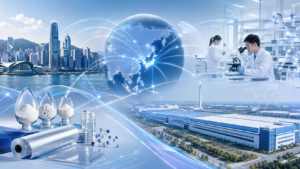
As global manufacturing continues to upgrade, overseas customers sourcing functional materials and specialty chemicals from China are looking for more than competitive pricing.
For industries such as automotive, semiconductor packaging, functional films, photovoltaics, high-performance resins, new energy, and other advanced manufacturing sectors, a reliable long-term materials partner must also provide:
- Stable manufacturing capabilities
- Continuous investment in R&D
- Strong understanding of customer applications
- Reliable quality control
- Technical service and formulation support
- International business and supply-chain capabilities
Hong Kong Langyi Technology Co., Limited was established to serve this international role.
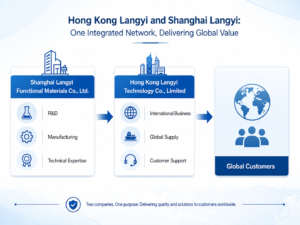
Hong Kong Langyi is a wholly owned subsidiary of Shanghai Langyi Functional Materials Co., Ltd., focusing on overseas market development, international customer service, global supply-chain coordination, and technical project communication.
Unlike a conventional trading company that mainly buys and resells products, Hong Kong Langyi is supported by Shanghai Langyi’s capabilities in R&D, manufacturing, application technology, and functional material development, together with manufacturing and technical resources in Shanghai and Shandong.
As a result, Hong Kong Langyi is more than an export platform.
It serves as a connection between:
China’s material technology and manufacturing capabilities + Hong Kong’s international business platform + global customer requirements.
Who Is Hong Kong Langyi?
Hong Kong Langyi Technology Co., Limited serves as Shanghai Langyi’s international business platform.
Its core functions include:
- Overseas customer development
- International market promotion
- Product and technical information coordination
- Sample and application-testing support
- International trade and supply-chain management
- Integration of China manufacturing resources
- Coordination of global customer technical requirements
For overseas customers, working with Hong Kong Langyi means more than simply finding a supplier in China.
It provides an international interface through which customers can access Shanghai Langyi’s R&D, manufacturing, and technical capabilities more efficiently.
More Than a Traditional Trading Company: An International Platform Backed by Manufacturing and R&D
Traditional chemical trading companies typically focus on:
product sourcing, quotations, export procedures, logistics, and commercial communication.
However, specialty functional materials often require much deeper technical understanding.
When selecting a functional additive or advanced material, customers may need to evaluate:
- Compatibility with resin systems
- Recommended dosage
- Particle size and dispersion
- Processing temperature
- Optical performance
- Electrical reliability
- Weather resistance
- Purity and ionic control
- Long-term stability
- Final product performance
This means an effective supply relationship requires both:
Commercial Support + Technical Support
Hong Kong Langyi combines international business capabilities with Shanghai Langyi’s material R&D and manufacturing resources.
Customers can therefore discuss not only:
“What material do we need?”
but also:
“What material-performance problem do we need to solve?”
Shanghai Langyi: The R&D and Manufacturing Foundation Behind Hong Kong Langyi
Founded in 2010, Shanghai Langyi Functional Materials Co., Ltd. focuses on the research, development, manufacturing, and application of specialty functional additives and advanced functional materials.
The company has established R&D and production capabilities in Shanghai and Shandong, supporting a material-development process that connects:
Material R&D → Formulation Development → Laboratory Testing → Pilot Validation → Scale Production → Customer Application
Shanghai-based technical resources support material research, application testing, technology development, and new-product validation, while the Shandong manufacturing base provides support for industrial-scale production and long-term supply.
This allows Langyi to connect laboratory innovation with commercial-scale manufacturing.
For overseas customers, this is particularly important.
A material that performs well in the laboratory does not automatically guarantee stable industrial production.
A mature materials supplier must be able to manage:
Technology + Scale-Up + Manufacturing + Quality + Supply
Langyi’s Five Functional Materials Technology Platforms
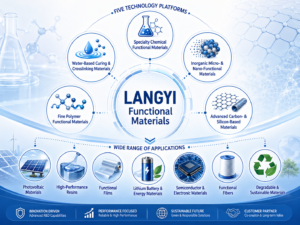
Langyi’s capabilities extend far beyond a small number of individual additives.
The company has developed a broader functional materials portfolio covering specialty chemical functional materials, water-based curing and crosslinking materials, inorganic micro- and nano-functional materials, fine polymer functional materials, and advanced carbon- and silicon-based materials.
1. Specialty Chemical Functional Materials
Langyi develops specialty functional materials designed to improve polymer performance and long-term durability.
Key product and technology directions include:
- Anti-hydrolysis agents
- Chain extenders
- UV-resistant materials
- UV-to-visible light conversion materials
- Infrared high-reflection materials
- Specialty monomers for photoresist-related applications
- Other high-performance functional additives
Anti-Hydrolysis Materials
Some polyesters, polyurethanes, and other polymer systems are vulnerable to hydrolysis under high-temperature and high-humidity conditions.
Hydrolysis may result in:
- Reduction in molecular weight
- Loss of mechanical properties
- Surface cracking
- Shorter service life
Anti-hydrolysis materials can help improve long-term stability under hot and humid environments.
Typical application systems may include:
- PET
- TPU
- PLA
- PBT
- Polyurethane
- Degradable polymers
- Polymer materials used in photovoltaic applications
Chain Extenders
Chain extenders can be used to improve molecular weight, processability, and mechanical performance in selected polymer systems.
They are particularly relevant to:
- Polyester materials
- Degradable polymers
- Recycled polymers
- High-performance resins
They can help improve melt strength, processing stability, and final material performance.
2. Water-Based Curing and Crosslinking Materials
As global coatings, adhesive, and polymer industries continue moving toward lower VOC emissions, environmentally responsible formulations, and water-based systems, water-based curing and crosslinking technologies are becoming increasingly important.
Langyi’s related product directions include:
- Carbodiimide curing agents
- Blocked isocyanate curing agents
- Oxazoline crosslinking agents
- Environmentally friendly water-based crosslinking materials
These products can be applied in:
- Water-based coatings
- Water-based adhesives
- Water-based inks
- Waterborne resins
- Functional coatings
- Film coatings
Their primary purpose is to improve:
- Water resistance
- Chemical resistance
- Adhesion
- Crosslinking density
- Durability
- Heat resistance
For manufacturers transitioning toward water-based systems, one of the key challenges is maintaining material performance while reducing VOC emissions.
Langyi’s water-based crosslinking technologies are developed around this requirement.
3. Inorganic Micro- and Nano-Functional Materials
Inorganic micro- and nano-functional materials represent one of Langyi’s key technology platforms.
The basic concept is to use micro- and nanoscale material design to introduce additional functionality into polymers, films, coatings, fibers, and electronic materials.
Main product directions include:
- Antimicrobial materials
- Deodorizing materials
- Infrared blocking agents
- Ionic adsorbents
- Antistatic materials
- Other micro- and nano-functional additives
Antimicrobial Materials
Antimicrobial functional materials can be incorporated into:
- Plastics
- Films
- Coatings
- Fibers
- Home-appliance materials
- Consumer materials
to provide long-lasting antimicrobial functionality.
Depending on the application, formulators need to evaluate:
- Antimicrobial performance
- Dosage
- Material compatibility
- Thermal resistance
- Durability
- Color impact
- Processing performance
Deodorizing Materials
Deodorizing functional materials are designed to control or reduce unwanted odors from materials or their surrounding environments.
Potential applications include:
- Polymer materials
- Fibers
- Automotive interior materials
- Packaging
- Coatings
- Consumer products
For automotive interiors, household products, and functional textiles, odor management has increasingly become an important part of perceived product quality.
Infrared Blocking Materials
Infrared blocking materials are designed to selectively manage near-infrared energy.
Typical applications include:
- Automotive window films
- PET functional films
- Architectural window films
- Heat-control coatings
- Transparent thermal-control sheets
- Optical polymer materials
The core technical objective is:
to reduce near-infrared transmission while maintaining high visible-light transparency.
For automotive window-film applications, manufacturers may also need to balance:
- VLT
- NIR performance
- TSER
- Haze
- Weather resistance
and other optical and durability requirements.
Ionic Adsorbents
Ionic adsorbents are designed to capture or immobilize specific ionic species in material systems.
In semiconductor packaging and electronic materials, mobile ions such as Cl⁻, Na⁺, and K⁺ may affect long-term material reliability.
Ionic adsorbents can help reduce the mobility of free ionic species and may be used in:
- Semiconductor packaging
- Epoxy Molding Compounds
- Underfill materials
- Electronic encapsulation resins
- High-purity polymer systems
- Functional coatings
The value of ionic adsorbents is not only about reducing total ionic content.
More importantly, they support:
Ion Management & Material Reliability
Antistatic Materials
Static charge accumulation can affect:
- Polymer processing
- Film winding
- Electronic components
- Dust attraction
- Surface quality
Antistatic materials can help improve the way electrical charge builds up and dissipates on material surfaces.
Potential applications include:
- Functional films
- Electronic materials
- Plastics
- Polymer systems
- Fibers
4. Fine Polymer Functional Materials
Langyi’s material-development capabilities also extend into fine polymer and functional polymer technologies.
Compared with conventional small-molecule additives, functional polymer systems often require consideration of:
- Molecular structure
- Polymer compatibility
- Molecular weight
- Melt processing
- Interfacial properties
- Final material performance
When customers face more complex material challenges, a single additive may not be sufficient.
In these cases, optimization may need to consider three levels together:
Polymer Matrix + Functional Additive + Processing
This is an important part of Langyi’s evolution from a functional-additives supplier toward a broader functional-materials solution provider.
5. Advanced Carbon- and Silicon-Based Functional Materials
Langyi is also expanding its technology portfolio into new energy, advanced electronics, and next-generation materials.
Current product directions include:
- Hard carbon
- Microporous carbon
- Silicon carbide
- Other advanced carbon- and silicon-based functional materials
Hard Carbon and Microporous Carbon
Advanced carbon materials are becoming increasingly important in new-energy and energy-storage applications.
Their performance can be strongly influenced by:
- Pore structure
- Surface characteristics
- Carbonization level
- Particle size
- Purity
- Electrochemical performance
With continued development in sodium-ion batteries and emerging energy-storage technologies, hard carbon and related materials are becoming important areas of research and industrialization.
Silicon Carbide
Silicon carbide offers properties including:
- High hardness
- Good heat resistance
- Strong chemical stability
- Good thermal performance
These characteristics give it broad potential in advanced industrial and electronic-material applications.
The development of these materials also reflects Langyi’s continued expansion from conventional specialty additives into a broader advanced functional-materials portfolio.
From Individual Additives to Integrated Material Solutions
Langyi’s strength is not simply defined by the number of products it supplies.
More importantly, it is the ability to integrate different material technologies around the customer’s final performance requirements.
For example, a functional-film manufacturer may simultaneously require:
- Infrared blocking
- UV resistance
- Antimicrobial functionality
- Antistatic performance
- Low haze
- Hydrolysis resistance
- Thermal stability
- Longer service life
These requirements are not independent from one another.
Improving one function can sometimes influence another property.
Therefore, the real challenge in functional-material development is often:
Performance Balance
Langyi’s multi-platform technology system enables technical teams to approach customer requirements from different material-science perspectives.
Key Industries Supported by Langyi
Langyi’s functional material technologies can be applied across a range of advanced manufacturing industries.
Photovoltaic and New-Energy Materials
Photovoltaic materials are exposed for long periods to:
- Sunlight
- UV radiation
- Heat
- Moisture
- Outdoor environments
As a result, long-term material durability is critical.
Relevant Langyi technologies include:
- Anti-hydrolysis materials
- UV stabilization
- Polymer modification
- Optical functional materials
- Infrared management
These technologies may be applied in photovoltaic encapsulation materials, backsheets, films, adhesives, and related polymer systems.
High-Performance Resins
High-performance resin systems may require improvements in:
- Heat resistance
- Hydrolysis resistance
- Chemical resistance
- Processing stability
- Mechanical properties
- Long-term durability
Langyi’s specialty functional chemicals and crosslinking technologies can support these performance requirements.
Functional Films
Functional films are an important application area for multiple Langyi technologies.
Relevant products include:
- Infrared blocking agents
- UV functional materials
- Antimicrobial materials
- Antistatic materials
- Anti-hydrolysis materials
Potential applications include:
- Automotive Window Film
- PET Functional Film
- Architectural Film
- Protective Film
- Optical Film
Semiconductor and Electronic Materials
Advanced semiconductor packaging demands high levels of material purity, reliability, and electrical performance.
Relevant Langyi technology directions include:
- Ionic adsorption
- Specialty photoresist-related monomers
- Inorganic functional materials
- Polymer functional materials
- High-purity material technologies
These material technologies can support challenges involving:
- Ionic contamination
- Package reliability
- Resin performance
- Material durability
- High-purity requirements
Lithium Battery and New-Energy Materials
As the global new-energy industry develops, battery materials are also becoming an important technology direction.
Relevant areas include:
- Hard carbon
- Microporous carbon
- Other advanced carbon materials
Functional Fibers
Langyi functional additives can also be introduced into fiber materials to provide properties such as:
- Antimicrobial performance
- Deodorization
- Antistatic behavior
- UV management
- Weather resistance
Degradable and Sustainable Materials
Biodegradable polymers offer environmental benefits but may also face technical challenges during processing and use, including:
- Molecular-weight reduction
- Insufficient melt strength
- Limited hydrolysis resistance
- Insufficient mechanical properties
Anti-hydrolysis agents, chain extenders, and other polymer-modification technologies can help improve processing and performance in selected degradable polymer systems.
How Does Hong Kong Langyi Bring Shanghai Langyi’s Material Capabilities to Global Markets?
Hong Kong Langyi’s international business is not limited to the few products currently highlighted on its website.
Depending on customer projects, industries, and regional requirements, Hong Kong Langyi can coordinate access to Shanghai Langyi’s broader functional-material portfolio, including:
Specialty Chemical Functional Materials
Water-Based Curing and Crosslinking Materials
Inorganic Micro- and Nano-Functional Materials
Fine Polymer Functional Materials
Advanced Carbon- and Silicon-Based Materials
At the same time, Hong Kong Langyi also works with selected manufacturers across mainland China that offer complementary technical, manufacturing, and quality capabilities.
When a customer requires materials outside Langyi’s own portfolio, Hong Kong Langyi can help coordinate suitable China-based manufacturing resources according to project requirements.
The result is an international material-supply model built around:
Langyi’s own R&D and manufacturing capabilities at the core, complemented by selected high-quality manufacturing resources across China.
How Is the LANGYI Model Different from a Traditional Trading Company?
| Capability | Traditional Trading Company | LANGYI Model |
|---|---|---|
| International trade | Yes | Yes |
| Product sourcing | Yes | Yes |
| In-house R&D support | Usually limited | Supported by Shanghai Langyi |
| Manufacturing resources | Not always available | Shanghai and Shandong resources |
| Application communication | Mainly commercial | Technical + commercial |
| Customized development | Dependent on external suppliers | Material-development support available |
| Sample technical evaluation | Mainly coordination | Can involve technical teams |
| China supply network | External suppliers | Own manufacturing + selected partners |
| Global customer service | Yes | Hong Kong international platform |
Langyi’s objective is therefore not simply:
Buy & Sell
but rather:
Technology + Manufacturing + Supply + Global Service
Why Do Global Customers Work with LANGYI?
When overseas customers evaluate a functional materials supplier in China, several questions are important:
Does the supplier have actual manufacturing capabilities?
Does the team understand the material application?
Can R&D and technical support be provided?
Is quality management stable and reliable?
Can the supplier support the project from sampling to scale production?
Can long-term supply stability be maintained?
Can additional manufacturing resources in China be coordinated if required?
The cooperation model between Hong Kong Langyi and Shanghai Langyi is designed around these requirements.
Looking for a Functional Materials Partner in China?
Whether you are developing:
- Automotive window films
- Functional PET films
- Semiconductor packaging materials
- High-performance resins
- Water-based coatings
- Functional fibers
- Photovoltaic materials
- New-energy materials
- Degradable polymers
- Other advanced industrial materials
material selection is only the first step.
A reliable long-term supply relationship also requires:
Technical Understanding + Reliable Manufacturing + Quality Control + Application Support + Long-Term Supply
Hong Kong Langyi serves as the global business interface connecting customers with Shanghai Langyi’s R&D, manufacturing, and material-technology capabilities.
Our objective is to help overseas customers:
connect more efficiently with China’s functional-material technologies and high-quality manufacturing resources.
Contact Hong Kong Langyi to discuss your material requirements, request samples, obtain technical information, or explore a long-term partnership.
Frequently Asked Questions
What is the relationship between Hong Kong Langyi and Shanghai Langyi?
Hong Kong Langyi Technology Co., Limited is a wholly owned subsidiary of Shanghai Langyi Functional Materials Co., Ltd.
Hong Kong Langyi primarily serves international markets and global customers, while Shanghai Langyi provides R&D, manufacturing, technical expertise, and application support.
Is Hong Kong Langyi a trading company?
Hong Kong Langyi carries out international trade and global supply activities.
However, its key difference from a conventional independent trading company is that it is directly supported by Shanghai Langyi’s R&D and manufacturing resources.
Its positioning is therefore closer to a:
Manufacturer-Backed International Business Platform
What products does Shanghai Langyi manufacture and develop?
Langyi’s portfolio extends beyond a single category of functional additives.
Its main technology and product directions include:
- Anti-hydrolysis materials
- Chain extenders
- UV functional materials
- Infrared functional materials
- Water-based crosslinking materials
- Antimicrobial materials
- Deodorizing materials
- Infrared blocking agents
- Ionic adsorbents
- Antistatic materials
- Fine polymer functional materials
- Hard carbon
- Microporous carbon
- Silicon carbide
- Other advanced functional materials
Which industries does Langyi support?
Key application sectors include:
- Photovoltaics
- High-performance resins
- Functional films
- Semiconductor and electronic materials
- Lithium battery and new-energy materials
- Functional fibers
- Degradable materials
as well as other advanced manufacturing industries that require functional material modification.
Can Langyi provide technical support?
Yes.
For functional materials, the product itself is only one part of the solution.
Technical communication and material selection can be carried out based on factors such as:
- Resin system
- Processing method
- Dosage
- Performance targets
- Compatibility
- Dispersion
- Reliability requirements
Can Hong Kong Langyi provide materials beyond Shanghai Langyi’s own portfolio?
Yes.
Hong Kong Langyi takes Langyi’s own R&D and manufacturing capabilities as its core foundation while also working with selected manufacturers across mainland China that offer strong technical and production capabilities.
For materials outside Langyi’s own portfolio, suitable manufacturing resources can be coordinated according to project requirements.
How can overseas customers start working with Langyi?
https://langyitechglobal.com/contact/
A typical cooperation process may include:
Application Requirement
↓
Technical Discussion
↓
Material Recommendation
↓
Sample Evaluation
↓
Technical Optimization
↓
Commercial Qualification
↓
Long-Term Supply
This process can help reduce material-selection risk and improve the efficiency of moving from sample evaluation to commercial application.
**********************************************************************************
隨著全球製造業持續升級,海外客戶在中國尋找功能材料與特種化學品供應商時,關注的已不再只是價格。
對汽車、半導體、功能薄膜、光伏、高性能樹脂、新能源及其他先進製造產業而言,一個值得長期合作的材料供應商,還需要具備:
– 穩定的製造能力
– 持續的研發投入
– 對客戶應用的理解
– 完善的品質控制
– 技術服務與配方支援
– 國際化商務與供應鏈能力
香港朗億科技有限公司(Hong Kong Langyi Technology Co., Limited) 正是在這一背景下建立的國際業務平台。
香港朗億是**上海朗億功能材料有限公司的全資子公司**,主要承擔海外市場開發、國際客戶服務、全球供應鏈協同及技術項目對接等職能。
與傳統單純進行產品買賣的貿易公司不同,香港朗億背後依託上海朗億在**研發、生產、應用技術及功能材料開發**方面的能力,並連結上海與山東的研發及製造資源。
因此,香港朗億所提供的不只是產品出口服務,而是一個:
**「中國材料技術與製造能力 + 香港國際商務平台 + 全球客戶需求」**
之間的連接窗口。
—
## 香港朗億是誰?
香港朗億科技有限公司是上海朗億面向國際市場的重要業務平台。
其核心職能包括:
– 海外客戶開發
– 國際市場推廣
– 產品及技術資料對接
– 樣品與應用測試協調
– 國際貿易及供應鏈管理
– 中國製造資源整合
– 全球客戶技術需求協調
對海外客戶而言,與香港朗億合作的價值不只是「找到一個中國供應商」,而是可以透過一個國際化窗口,直接連接上海朗億的研發、生產與技術能力。
—
## 不只是傳統貿易公司,而是製造與研發能力支持的國際平台
傳統化工貿易公司通常主要負責:
產品尋源、詢價、出口、物流及商務溝通。
但對功能材料而言,單純提供產品型號往往並不足夠。
客戶在選擇一款功能添加劑或先進材料時,通常還需要考慮:
– 材料與樹脂的相容性
– 添加量
– 粒徑與分散性
– 加工溫度
– 光學性能
– 電氣可靠性
– 耐候性能
– 純度與離子控制
– 長期使用穩定性
– 最終產品性能
因此,真正有效的供應關係需要同時具備:
**Commercial Support + Technical Support**
香港朗億的定位正是將國際商務能力與上海朗億的材料研發及製造能力結合起來。
客戶不只是告訴我們:
**「需要什麼材料。」**
也可以進一步討論:
**「希望解決什麼材料性能問題。」**
—
# 上海朗億:香港朗億背後的研發與製造基礎
上海朗億功能材料有限公司成立於 2010 年,是一家專注於**特殊功能助劑與先進功能材料**研發、生產及應用的科技型企業。
公司在上海與山東建立研發及生產能力,形成從:
**材料研發 → 配方設計 → 實驗測試 → 中試 → 規模化生產 → 客戶應用**
較為完整的材料產業化鏈條。
上海研發資源主要承擔材料研究、應用測試、技術開發及新產品驗證,而山東製造基地則為規模化生產與長期供應提供支持。
這使朗億能夠從實驗室材料開發延伸至工業化量產。
對海外客戶而言,這一點尤其重要。
因為一款材料在實驗室中表現良好,並不代表它一定能夠穩定地進入商業化生產。
真正成熟的材料供應商需要同時解決:
**Technology + Scale-up + Manufacturing + Quality + Supply**
—
# 朗億的五大功能材料技術平台
朗億的能力並不侷限於幾款單一產品。
目前,公司已經圍繞多個功能材料方向建立較完整的產品與技術體系,涵蓋**特殊化學功能材料、水性固化與交聯材料、無機微奈米功能材料、精細高分子材料,以及先進碳基與矽基材料**。
—
## 1. 特殊化學功能材料
朗億開發多種用於改善高分子材料性能與長期耐久性的特殊功能材料。
主要產品及技術方向包括:
– 抗水解劑
– 擴鏈劑
– UV 耐候材料
– 紫外轉可見光材料
– 紅外高反射材料
– 光阻材料相關特殊單體
– 其他高性能功能添加劑
### 抗水解材料
部分聚酯、聚氨酯及其他高分子材料在高溫、高濕環境下容易發生水解,進一步導致:
– 分子量下降
– 機械性能下降
– 表面龜裂
– 使用壽命縮短
抗水解材料可以幫助提升材料在濕熱環境中的長期穩定性。
典型應用包括:
– PET
– TPU
– PLA
– PBT
– 聚氨酯
– 可降解材料
– 光伏相關高分子材料
### 擴鏈劑
擴鏈劑可用於改善部分聚合物的分子量、加工性能及機械性能。
特別適用於:
– 聚酯材料
– 可降解材料
– 再生材料
– 高性能樹脂
可協助提升材料的熔體強度、加工穩定性及最終產品性能。
—
## 2. 水性固化與交聯材料
隨著全球塗料、膠黏劑及高分子產業持續向**低 VOC、環保化與水性化**方向發展,水性固化與交聯技術的重要性快速提升。
朗億相關產品包括:
– 碳化二亞胺類固化劑
– 封閉型異氰酸酯
– 噁唑啉類交聯劑
– 水性環保交聯材料
這類產品可以應用於:
– 水性塗料
– 水性膠黏劑
– 水性油墨
– 水性樹脂
– 功能塗層
– 薄膜塗層
主要用於改善:
– 耐水性
– 耐化學性
– 附著力
– 交聯密度
– 耐久性
– 耐熱性能
對正在進行水性化轉型的製造商而言,如何在降低 VOC 的同時保持材料性能,是一項重要挑戰。
朗億的水性交聯技術正是圍繞這一需求進行開發。
—
# 3. 無機微奈米功能材料
無機微奈米材料是朗億的重要技術平台之一。
其核心理念是透過微奈米尺度材料設計,使普通高分子、薄膜、塗層或電子材料獲得新的功能。
主要產品方向包括:
– 抗菌材料
– 除味材料
– 紅外阻隔劑
– 離子吸附劑
– 抗靜電材料
– 其他微奈米功能助劑
—
## 抗菌材料
抗菌功能材料可加入:
– 塑膠
– 薄膜
– 塗層
– 纖維
– 家電材料
– 消費品材料
使產品獲得長效抗菌功能。
根據不同應用,需要綜合考慮:
– 抗菌效率
– 添加量
– 材料相容性
– 耐熱性
– 耐久性
– 顏色影響
– 加工性能
—
## 除味材料
除味功能材料主要用於控制或降低材料與環境中的異味物質。
可應用於:
– 高分子材料
– 纖維
– 車內材料
– 包裝
– 塗層
– 消費品
對汽車內飾、家居及功能纖維等產業而言,氣味控制已逐漸成為產品品質的重要組成部分。
—
## 紅外阻隔材料
紅外阻隔材料可以選擇性管理近紅外能量。
典型應用包括:
– 汽車窗膜
– PET 功能膜
– 建築窗膜
– 隔熱塗層
– 透明隔熱板材
– 高分子光學材料
其核心目標是:
**降低近紅外透過,同時保持較高的可見光透明度。**
對汽車窗膜而言,還需要同時兼顧:
– VLT
– NIR
– TSER
– Haze
– Weather Resistance
等性能。
—
## 離子吸附劑
離子吸附材料主要用於捕捉或固定材料中的特定離子。
在半導體封裝及電子材料中,Cl⁻、Na⁺、K⁺ 等可移動離子可能影響材料長期可靠性。
離子吸附劑可協助降低自由離子的移動能力,適用於:
– 半導體封裝
– Epoxy Molding Compound
– Underfill
– 電子封裝樹脂
– 高純度高分子體系
– 功能塗層
這類材料的核心價值並不只是降低總離子含量,而是改善:
**Ion Management & Material Reliability**
—
## 抗靜電材料
靜電累積可能影響:
– 塑膠加工
– 薄膜收卷
– 電子元件
– 粉塵吸附
– 產品表面品質
抗靜電功能材料可以改善材料表面的電荷累積與釋放特性。
相關應用包括:
– 功能薄膜
– 電子材料
– 塑膠
– 高分子材料
– 纖維
—
# 4. 精細高分子功能材料
朗億的材料研發能力也延伸至精細高分子與功能聚合物領域。
相比傳統小分子添加劑,高分子功能材料需要同時考慮:
– 分子結構
– 聚合物相容性
– 分子量
– 熔融加工
– 介面性能
– 最終材料性能
當客戶需要解決較複雜的材料問題時,單一添加劑可能無法完全滿足需求。
這時就需要從:
**Polymer Matrix + Functional Additive + Processing**
三個層面共同進行優化。
這也是朗億從「功能助劑供應商」逐步向「功能材料解決方案提供者」發展的重要方向。
—
# 5. 先進碳基與矽基功能材料
朗億也持續布局新能源、先進電子及下一代材料技術。
目前相關產品方向包括:
– 硬碳
– 微孔碳
– 碳化矽
– 其他碳基及矽基功能材料
—
## 硬碳與微孔碳
先進碳材料正在新能源與儲能領域發揮越來越重要的作用。
材料性能與以下特性密切相關:
– 孔隙結構
– 表面性質
– 碳化程度
– 粒徑
– 純度
– 電化學性能
隨著鈉離子電池及新型儲能技術的發展,硬碳等材料正在成為重要的研究與產業方向。
—
## 碳化矽
碳化矽具備:
– 高硬度
– 良好耐熱性
– 優異化學穩定性
– 良好的熱性能
因此,在先進工業材料及電子材料領域具有廣泛的發展潛力。
這些新材料方向,也體現了朗億從傳統功能助劑逐步向更廣泛的先進功能材料體系延伸。
—
# 從單一添加劑到整合式材料解決方案
朗億真正的競爭力並不只是擁有多少產品。
更重要的是:
**能否圍繞客戶的最終性能需求,整合不同材料技術。**
例如,一家功能薄膜製造商可能同時需要:
– 紅外阻隔
– UV 耐候
– 抗菌
– 抗靜電
– 低霧度
– 耐水解
– 耐高溫
– 更長使用壽命
這些需求並不是彼此獨立的。
提高某一種功能,有時可能影響另一項性能。
因此,功能材料開發真正需要解決的是:
**Performance Balance —— 性能平衡。**
朗億多平台的材料技術體系,使技術團隊可以從不同材料科學角度理解與解決客戶問題。
—
# 朗億服務的主要產業
朗億的功能材料技術目前可應用於多個先進製造領域。
—
## 光伏與新能源
光伏材料長期暴露於:
– 太陽光
– UV
– 高溫
– 濕氣
– 戶外環境
因此,材料耐久性非常重要。
相關朗億技術包括:
– 抗水解
– UV 穩定
– 聚合物改性
– 光學功能材料
– 紅外管理
可應用於光伏封裝材料、背板、薄膜、膠黏劑及其他高分子體系。
—
## 高性能樹脂
高性能樹脂通常需要提升:
– 耐熱
– 耐水解
– 耐化學
– 加工穩定
– 機械性能
– 長期耐久
朗億的特殊功能化學品與交聯技術可用於改善這些性能。
—
## 功能薄膜
功能膜是朗億多種技術的重要應用領域。
相關產品包括:
– 紅外阻隔劑
– UV 功能材料
– 抗菌材料
– 抗靜電材料
– 抗水解材料
可應用於:
– Automotive Window Film
– PET Functional Film
– Architectural Film
– Protective Film
– Optical Film
—
## 半導體與電子材料
先進半導體封裝對材料純度、可靠性與電氣性能提出極高要求。
朗億相關技術方向包括:
– 離子吸附
– 特殊光阻單體
– 無機功能材料
– 高分子功能材料
– 高純度材料技術
可協助解決:
– 離子污染
– 封裝可靠性
– 樹脂性能
– 材料耐久
– 高純度要求
等問題。
—
## 鋰電與新能源材料
隨著全球新能源產業快速發展,電池材料也成為朗億持續布局的重要領域。
包括:
– 硬碳
– 微孔碳
– 其他先進碳材料
等技術方向。
—
## 功能纖維
朗億多種功能添加劑可以導入纖維材料,提供:
– 抗菌
– 除味
– 抗靜電
– UV 管理
– 耐候
等功能。
—
## 可降解與永續材料
生物可降解材料雖然具有環境優勢,但在實際加工及使用過程中往往面臨:
– 分子量下降
– 熔體強度不足
– 耐水解性能不足
– 機械性能不足
等問題。
抗水解劑、擴鏈劑及其他聚合物改性技術,可以幫助改善部分可降解材料的加工與使用性能。
—
# 香港朗億如何把上海朗億的材料能力帶向全球?
香港朗億的國際業務並不侷限於香港官網目前重點展示的少數產品。
根據不同國家、產業與客戶專案需求,香港朗億可以協調上海朗億更廣泛的功能材料產品與技術資源。
包括:
**特殊化學功能材料**
**水性交聯與固化材料**
**無機微奈米功能材料**
**精細高分子功能材料**
**先進碳基與矽基材料**
同時,香港朗億也與中國內地其他具有技術及製造優勢的企業保持合作。
當客戶需要朗億自有產品之外的補充材料時,香港朗億可以進一步協調合適的中國製造資源。
因此,香港朗億所建立的是一個:
**以朗億自身研發與製造能力為核心,並由優質中國製造資源進行補充的國際材料供應平台。**
—
# 傳統貿易公司與朗億模式有何不同?
| 能力傳統貿易公司LANGYI 模式 | | |
| —————– | ——- | ————- |
| 國際貿易 | ✓ | ✓ |
| 產品尋源 | ✓ | ✓ |
| 自有研發能力 | 通常有限 | 上海朗億研發支持 |
| 自有製造資源 | 不一定 | 上海及山東基地 |
| 應用技術溝通 | 主要商務 | 技術 + 商務 |
| 客製化開發 | 依賴外部供應商 | 可提供材料研發支持 |
| 樣品技術評估 | 主要負責協調 | 可結合技術團隊 |
| 中國供應鏈 | 外部供應商 | 自有製造 + 精選合作夥伴 |
| 全球客戶服務 | ✓ | 香港國際平台 |
因此,朗億希望建立的並不是單純的:
**Buy & Sell**
而是:
**Technology + Manufacturing + Supply + Global Service**
—
# 為什麼全球客戶選擇 LANGYI?
海外客戶在評估一家中國功能材料供應商時,可以重點考慮:
**是否具備實際製造能力?**
**是否真正理解材料應用?**
**是否可以提供研發及技術支持?**
**是否具備穩定的品質管理?**
**是否可以支援從樣品到量產?**
**是否具備長期穩定供應能力?**
**是否可以協助整合更多中國製造資源?**
香港朗億與上海朗億的協同模式,正是圍繞這些問題建立。
—
# 正在尋找中國功能材料合作夥伴?
無論您正在開發:
– 汽車窗膜
– 功能 PET 薄膜
– 半導體封裝材料
– 高性能樹脂
– 水性塗層
– 功能纖維
– 光伏材料
– 新能源材料
– 可降解高分子
– 其他先進工業材料
材料選型都只是產品開發的第一步。
真正穩定的供應關係還需要:
**技術理解、可靠製造、品質控制、應用支持與長期供應能力。**
香港朗億作為全球業務窗口,連接上海朗億的研發、製造與材料技術平台。
我們希望幫助更多海外客戶:
**更高效地連結中國功能材料技術與優質製造資源。**
**歡迎聯繫 Hong Kong Langyi,與我們討論您的材料需求、申請樣品、獲取技術資料或探索長期合作機會。**
—
# 常見問題 FAQ
## 香港朗億與上海朗億是什麼關係?
香港朗億科技有限公司是上海朗億功能材料有限公司的全資子公司。
香港朗億主要作為國際市場與全球客戶服務平台,上海朗億則提供研發、製造、技術與應用支持。
—
## 香港朗億是一家貿易公司嗎?
香港朗億承擔國際貿易與全球供應業務,但與傳統獨立貿易公司的最大不同,是其直接依託上海朗億的研發與製造資源。
因此,其定位更接近:
**Manufacturer-Backed International Business Platform**
也就是:
**由製造商與研發能力支持的國際業務平台。**
—
## 上海朗億主要生產哪些產品?
朗億產品並不侷限於單一功能助劑。
主要技術與產品方向包括:
– 抗水解材料
– 擴鏈劑
– UV 功能材料
– 紅外功能材料
– 水性交聯材料
– 抗菌材料
– 除味材料
– 紅外阻隔劑
– 離子吸附劑
– 抗靜電材料
– 精細高分子材料
– 硬碳
– 微孔碳
– 碳化矽
– 其他先進功能材料
—
## 朗億主要服務哪些產業?
主要應用領域包括:
– 光伏
– 高性能樹脂
– 功能薄膜
– 半導體與電子材料
– 鋰電與新能源
– 功能纖維
– 可降解材料
以及其他需要材料功能改性的先進製造產業。
—
## Langyi 可以提供技術支持嗎?
可以。
對功能材料而言,產品本身只是解決方案的一部分。
技術團隊可以圍繞客戶的:
– 樹脂體系
– 加工方法
– 添加量
– 性能目標
– 相容性
– 分散
– 可靠性
等條件進行技術交流與材料選型。
—
## 香港朗億是否可以提供上海朗億產品之外的材料?
可以。
香港朗億以朗億自身研發與製造能力為核心,同時也與中國內地具有技術及製造優勢的企業合作。
對於朗億自有產品以外的材料需求,可以根據專案情況協調相關中國製造資源。
—
## 海外客戶如何與 Langyi 開始合作?
通常可以從以下流程開始:
**Application Requirement**
↓
**Technical Discussion**
↓
**Material Recommendation**
↓
**Sample Evaluation**
↓
**Technical Optimization**
↓
**Commercial Qualification**
↓
**Long-Term Supply**
這種方式有助於降低材料選型風險,並提高從樣品測試到商業化應用的效率。 生成英文版