
Introduction
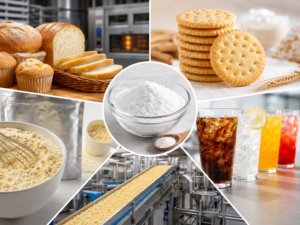
Food manufacturers often think of sodium bicarbonate simply as baking soda. In industrial food processing, however, its role can be much broader.
Food-grade sodium bicarbonate can function as a leavening ingredient, acidity regulator, processing aid and formulation component in bakery products, beverages and other food-processing systems. LANGYI’s current food-grade sodium bicarbonate portfolio includes Standard Food Grade, Low-Salt Grade and Fine-Powder Grade, designed for different processing requirements involving general food production, chloride control, dissolution and dispersion.
For manufacturers, choosing the right grade is therefore not only a question of chemical purity.
Particle size, chloride specification, dissolution behavior, moisture control and interaction with other formulation ingredients can all influence processing consistency and final product performance.
This guide explains how food-grade sodium bicarbonate works and how food manufacturers can evaluate different grades for their formulations.
What Is Food-Grade Sodium Bicarbonate?
Sodium bicarbonate, also known as sodium hydrogen carbonate or baking soda, has the chemical formula NaHCO₃.
The Joint FAO/WHO Expert Committee on Food Additives identifies sodium hydrogen carbonate as INS 500(ii) and lists CAS No. 144-55-8. Codex information recognizes sodium hydrogen carbonate for several technological functions in foods, including acidity regulation and other food-additive functions.
In the United States, FDA’s food-substance database lists sodium bicarbonate in connection with 21 CFR 184.1736. Manufacturers selling into different markets should always verify the applicable food category, permitted use and local regulatory requirements for the intended application.
LANGYI’s Food-Grade Sodium Bicarbonate is described as a high-purity white crystalline powder manufactured according to GB 1886.2-2015. The current product specification lists NaHCO₃ content at 99.0–100.5%, loss on drying at ≤0.20%, and pH of a 10 g/L aqueous solution at ≤8.5.
How Sodium Bicarbonate Works in Food Formulations
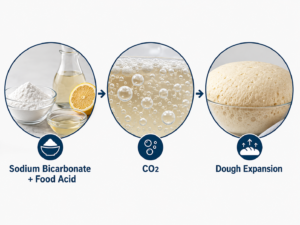
Leavening and Carbon Dioxide Generation
One of the best-known applications of sodium bicarbonate is chemical leavening.
When bicarbonate reacts with an acidic ingredient, carbon dioxide is generated:
HCO₃⁻ + H⁺ → CO₂ + H₂O
The carbon dioxide forms gas cells in dough or batter. During baking, these cells expand and contribute to volume and texture.
Sodium bicarbonate can also decompose when heated, releasing carbon dioxide and water.
This explains its widespread use in products such as:
- Bread
- Cakes
- Biscuits
- Pastries
- Steamed flour products
- Baking powder systems
LANGYI’s current application guidance specifically lists baking powder, breads, cakes, biscuits, pastries and steamed flour products among the intended food-processing applications.
The practical challenge is balance.
Too little bicarbonate may not generate enough gas, while an inappropriate balance between bicarbonate and acidic components can also influence final pH, flavor, color and processing behavior.
For this reason, industrial manufacturers should determine dosage according to the complete formulation rather than treating sodium bicarbonate as an isolated ingredient.
pH and Acidity Adjustment
Sodium bicarbonate forms a mildly alkaline aqueous solution and can therefore be used in formulations requiring controlled acidity or pH adjustment.
This can be useful when manufacturers need to influence:
- Acid-base balance
- Processing conditions
- Flavor profile
- Ingredient interaction
- Reaction behavior
Codex GSFA information also classifies sodium hydrogen carbonate as an acidity regulator.
However, pH control should always be evaluated in the complete food system because proteins, organic acids, salts and other ingredients may affect buffering behavior.
Why Sodium Bicarbonate Grade Matters
From a chemical perspective, Standard Food Grade, Low-Salt Grade and Fine-Powder Grade are all sodium bicarbonate.
From a processing perspective, they are not necessarily interchangeable.
A bakery formulation requiring routine leavening may place the highest priority on consistency and general food-grade specifications.
A formulation sensitive to chloride may need tighter chloride control.
A dry premix or fast-dissolving application may benefit from tighter particle-size control.
This is why material selection should begin with the processing problem rather than with the product name alone.
LANGYI currently offers three sodium bicarbonate grades to address these different requirements.
Comparing Standard, Low-Salt and Fine-Powder Sodium Bicarbonate
| Grade | Key Characteristic | Current LANGYI Specification Highlight | Typical Selection Logic |
|---|---|---|---|
| Standard Food Grade | General-purpose food-grade material | NaHCO₃ 99.0–100.5%; Cl⁻ ≤0.40% | General bakery, beverage and food-processing applications |
| Low-Salt Grade | Tighter chloride control | Cl⁻ ≤0.02% or customized | Formulations requiring lower chloride content |
| Fine-Powder Grade | Controlled fine particle size | ≥99.9% ≤150 μm or customized | Rapid dissolution, mixing and uniform dispersion |
The values above are taken from LANGYI’s current product specification.
An important clarification is that LANGYI’s term “Low-Salt Grade” refers to its controlled chloride specification. It should not be interpreted as a low-sodium version of sodium bicarbonate. This distinction is important when communicating specifications with food manufacturers.
Key Technical Parameters to Evaluate
NaHCO₃ Content and Purity
LANGYI currently specifies sodium bicarbonate content at 99.0–100.5% for its food-grade product range.
Purity matters because inconsistent raw material composition can create variation in formulation performance.
Industrial buyers should therefore review the complete specification and COA rather than focusing only on the ingredient name.
Chloride Control
Chloride may not be the primary selection criterion in every food application, but certain formulations or downstream processes may require tighter control.
LANGYI lists:
- Standard / Fine Grade: Cl⁻ ≤0.40%
- Low-Salt Grade: Cl⁻ ≤0.02% or customized
Where chloride sensitivity is important, specifying the required limit during supplier qualification can help avoid using unnecessarily broad material specifications.
Particle Size and Dispersion
Particle size can influence how quickly a powder disperses, dissolves and distributes through a formulation.
LANGYI’s Fine-Powder Sodium Bicarbonate is specified with ≥99.9% of particles at ≤150 μm, with customized specifications also available.
Fine-powder material may be particularly useful where manufacturers require:
- Rapid dissolution
- Uniform dry blending
- Better distribution through premixes
- More consistent local concentration
Particle size should still be evaluated together with powder handling, dust control, mixing equipment and process design.
Moisture and Storage Stability
Sodium bicarbonate should be protected from moisture, excessive heat, acids, strong odors and contamination.
LANGYI recommends storage in a cool, dry and well-ventilated place with the packaging tightly sealed.
Moisture control matters because powder flow and storage stability can deteriorate if packaging is improperly handled.
For food manufacturers, correct warehouse management is therefore part of ingredient quality control.
Food Processing Applications
Bakery and Leavening Systems
Bakery is one of the most familiar applications.
Sodium bicarbonate can be incorporated into baking powder systems and formulations for bread, cakes, biscuits, pastries and steamed flour products.
The appropriate grade depends on the production system.
Standard grade may suit general applications, while fine powder may be attractive where uniform dispersion through a dry premix is particularly important.
Carbonated Beverages and Soda Water
LANGYI also lists carbonated beverages and soda water among its food application scenarios.
In beverage systems, dissolution and pH management can be important processing considerations.
Because beverage formulations differ significantly in acidity and ingredients, manufacturers should validate the bicarbonate level within the actual formulation.
Food Acidity and pH Adjustment
Sodium bicarbonate can be used where mild alkalinity or buffering behavior is required.
This may include formulations where manufacturers need to moderate acidity or create more controlled processing conditions. Its Codex classification as an acidity regulator supports this technological role.
Fruit and Vegetable Washing
LANGYI’s current application list includes fruit and vegetable washing.
For any food-contact washing application, processors should establish concentration, contact conditions and rinsing procedures according to the applicable production standard and local regulations.
Meat Processing
Meat tenderization and other food-processing applications are also listed among LANGYI’s potential application scenarios.
Because sodium bicarbonate can change local pH, its effect on texture, flavor and processing behavior should be validated through formulation and production trials.
How to Select the Right Sodium Bicarbonate Grade
Food manufacturers can begin with five questions.
1. What is the main function?
Is the material required for:
- Leavening?
- pH adjustment?
- Dry premixing?
- Beverage processing?
- Another processing function?
The answer determines which properties matter most.
2. Is chloride control important?
If yes, a tighter-chloride grade may be appropriate.
LANGYI’s Low-Salt Grade is specifically differentiated by a chloride specification of ≤0.02% or customized.
3. Does the process require faster dissolution or better dispersion?
Fine-Powder Grade may be more suitable where particle distribution is a key process variable.
4. What regulatory specification applies?
Food-additive requirements differ by country, food category and intended use. JECFA/Codex identifies sodium hydrogen carbonate as INS 500(ii), while FDA lists sodium bicarbonate under its U.S. food-substance regulatory framework. Buyers should verify market-specific requirements before commercial use.
5. What does the final formulation require?
Bench and pilot testing remain important.
The optimum choice should be based on final product performance—not on the raw-material specification alone.
Common Formulation Considerations
A technically sound sodium bicarbonate qualification program should evaluate:
- Reaction with acidic ingredients
- Final product pH
- Gas generation behavior
- Mixing uniformity
- Dissolution
- Flavor impact
- Product color
- Moisture sensitivity
- Finished-product texture
- Production repeatability
Manufacturers should also avoid assuming that finer powder is automatically better.
Fine material may improve dispersion, but powder handling and manufacturing conditions also need to be considered.
Similarly, a tighter chloride specification is valuable when the formulation requires it, but may provide little practical benefit where chloride is not a critical parameter.
Select the grade according to the process requirement—not simply the highest specification.
Food-Grade Sodium Bicarbonate from LANGYI
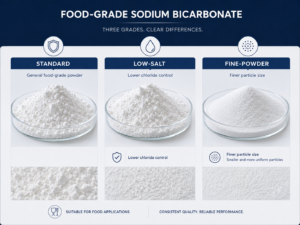
LANGYI currently supplies three food-grade sodium bicarbonate options:
Standard Food-Grade Sodium Bicarbonate
for general food-processing requirements.
Low-Salt Sodium Bicarbonate
with controlled chloride content of ≤0.02% or customized.
Fine-Powder Sodium Bicarbonate
with ≥99.9% of particles ≤150 μm, or customized particle-size specifications.
The current product specification also lists:
- NaHCO₃: 99.0–100.5%
- Loss on Drying: ≤0.20%
- pH, 10 g/L solution: ≤8.5
- Arsenic as As: ≤1.0 mg/kg
- Heavy Metals as Pb: ≤5.0 mg/kg
- Whiteness: ≥85.0
- Applicable standard: GB 1886.2-2015
Packaging options currently include 25 kg laminated woven bags and 500 kg, 1,000 kg and 1,250 kg bulk bags, with customized packaging available upon request. https://langyitechglobal.com/product/sodium-bicarbonate/
Looking for Food-Grade Sodium Bicarbonate for Your Formulation?
Selecting sodium bicarbonate should begin with your process requirements.
If you are developing bakery products, dry mixes, beverages or other food formulations and need to evaluate standard, controlled-chloride or fine-powder sodium bicarbonate, contact LANGYI to discuss:
- Required specification
- Particle-size requirements
- Chloride target
- Packaging
- Application
- Sample evaluation
Contact Hong Kong Langyi to request product specifications, COA information, samples or a customized quotation. https://langyitechglobal.com/contact/
Frequently Asked Questions
What is food-grade sodium bicarbonate?
Food-grade sodium bicarbonate is sodium hydrogen carbonate produced to a food-use specification. It is also known as baking soda and is identified by JECFA/Codex as INS 500(ii).
What is sodium bicarbonate used for in food processing?
Applications include leavening, acidity and pH adjustment, baking formulations, beverages and other food-processing functions. LANGYI also lists fruit and vegetable washing and meat-processing applications.
What is the difference between standard and fine-powder sodium bicarbonate?
The main difference in LANGYI’s current portfolio is particle-size control. Fine-Powder Grade specifies ≥99.9% of particles at ≤150 μm or a customized specification.
What does Low-Salt Sodium Bicarbonate mean?
In LANGYI’s current product range, Low-Salt Grade refers to tighter chloride control, with Cl⁻ specified at ≤0.02% or customized. It is not a low-sodium formulation.
Is sodium bicarbonate the same as baking soda?
Yes. JECFA lists baking soda, bicarbonate of soda and sodium bicarbonate as synonyms for sodium hydrogen carbonate.
How should sodium bicarbonate be stored?
It should be stored in a cool, dry, well-ventilated area, tightly sealed and protected from moisture, heat, acids, odors and contamination.
External References
- FAO/WHO JECFA — Sodium Hydrogen Carbonate: identity, CAS No. 144-55-8 and INS 500(ii).
- Codex GSFA — Sodium Hydrogen Carbonate: recognized technological functions and food-additive information.
- U.S. FDA — Sodium Bicarbonate: food-substance records and 21 CFR 184.1736 reference.
- European Commission Food Additives Database — Sodium Carbonates (E500): EU food-additive framework and authorized-use database.
- LANGYI — Food-Grade Sodium Bicarbonate: current grades, technical parameters, applications and packaging.
*******************************************************************************************************
食品級碳酸氫鈉:功能、規格與食品加工選型指南
很多人提到碳酸氫鈉時,首先想到的是「小蘇打」。
但在工業食品加工領域,**食品級碳酸氫鈉(Food-Grade Sodium Bicarbonate)**並不只是家庭烘焙原料。
它可以作為膨鬆配方中的重要組分,也可以用於酸度與 pH 調節、食品加工及其他配方體系。
朗億目前提供三種食品級碳酸氫鈉:
- Standard Food Grade 標準食品級
- Low-Salt Grade 低鹽級
- Fine-Powder Grade 細粉級
三種產品分別針對一般食品加工、更嚴格的氯離子控制,以及快速溶解與均勻分散等不同製程需求。
因此,食品製造商在選擇碳酸氫鈉時,不應只比較「純度」。
粒徑、氯離子含量、溶解與分散性能、儲存穩定性,以及它與其他配方成分之間的反應,都可能影響最終食品的加工穩定性與品質。
什麼是食品級碳酸氫鈉?
碳酸氫鈉的化學式為 NaHCO₃,英文名稱包括 Sodium Bicarbonate、Sodium Hydrogen Carbonate 及 Baking Soda。
FAO/WHO 聯合食品添加劑專家委員會 JECFA 將 Sodium Hydrogen Carbonate 列為 INS 500(ii),CAS No. 為 144-55-8。
Codex GSFA 中亦收錄 Sodium Hydrogen Carbonate,並將其列入酸度調節等食品添加劑功能類別。
在美國,FDA 食品物質資料庫亦列有 Sodium Bicarbonate,並連結至 21 CFR 184.1736。不同國家、食品類別與用途的實際使用要求可能不同,因此出口食品製造商仍需要根據目的市場確認相應法規。
朗億目前的食品級碳酸氫鈉為白色結晶粉末,依 GB 1886.2-2015 生產。產品頁列出的 NaHCO₃ 含量為 99.0–100.5%,乾燥減量 ≤0.20%,10 g/L 水溶液 pH ≤8.5。
碳酸氫鈉如何在食品配方中發揮作用?
膨鬆與二氧化碳產生
碳酸氫鈉最廣為人知的功能之一,就是烘焙膨鬆。
當碳酸氫根與酸性成分反應時,可以形成二氧化碳:
HCO₃⁻ + H⁺ → CO₂ + H₂O
產生的 CO₂ 在麵糰或麵糊中形成氣泡。
加熱後,氣泡膨脹,從而影響產品的:
- 體積
- 孔隙結構
- 鬆軟程度
- 組織口感
因此,碳酸氫鈉可以應用於:
- 麵包
- 蛋糕
- 餅乾
- 糕點
- 蒸製麵食
- 複合膨鬆配方
這些應用也列於朗億目前的產品頁中。
但是,膨鬆配方並不是「碳酸氫鈉添加越多越好」。
真正重要的是:
碳酸氫鈉與配方中酸性組分的平衡。
如果兩者比例不匹配,除了可能影響 CO₂ 釋放,也可能改變最終產品的 pH、色澤、風味及組織。
因此,工業食品製造商應基於完整配方進行添加量驗證。
pH 與酸度調節
碳酸氫鈉溶於水後形成溫和的鹼性體系,因此可以應用於需要酸度或 pH 調節的食品配方。
這類應用可能涉及:
- 調節酸鹼平衡
- 改變製程條件
- 影響配方反應
- 控制成分之間的作用
- 調整最終產品特性
Codex GSFA 亦將 Sodium Hydrogen Carbonate 列為 Acidity Regulator。
但食品本身通常是一個複雜的緩衝體系。
蛋白質、有機酸、鹽類及其他成分都可能影響 pH,因此實際添加效果仍應在完整配方中驗證。
為什麼食品級碳酸氫鈉需要區分不同等級?
從化學名稱看,Standard、Low-Salt 與 Fine-Powder 都是 NaHCO₃。
但從食品加工角度來看,它們不一定完全相同。
例如:
一般烘焙產品可能更重視穩定供貨與基本食品級規格。
某些對氯離子較敏感的配方可能需要更嚴格的 Chloride Control。
乾粉預混、快速溶解或需要均勻分布的配方,則可能更重視粒徑控制。
因此,選擇食品級碳酸氫鈉時應該先問:
「我的製程需要解決什麼問題?」
而不是只問:
「哪一款規格最高?」
Standard、Low-Salt 與 Fine-Powder 如何選?
| 等級 | 主要特點 | 朗億目前規格重點 | 選型方向 |
|---|---|---|---|
| Standard Food Grade | 一般食品加工 | NaHCO₃ 99.0–100.5%;Cl⁻ ≤0.40% | 一般烘焙、飲料及食品加工 |
| Low-Salt Grade | 更嚴格氯離子控制 | Cl⁻ ≤0.02% 或可定制 | 對氯離子控制要求較高的配方 |
| Fine-Powder Grade | 細粒徑 | ≤150 μm 粒子 ≥99.9% 或可定制 | 快速溶解、乾混及均勻分散 |
以上數據均來自朗億當前 Sodium Bicarbonate 產品頁。
這裡有一點特別需要說明:
朗億產品名稱中的 Low-Salt Grade,核心差異是更嚴格的 Chloride 氯離子控制。
因此,它不應被理解成「低鈉碳酸氫鈉」。
對海外客戶進行產品溝通時,建議使用:
Low-Salt / Low-Chloride Grade
並在 TDS 或報價中直接標明 chloride specification,這樣更不容易產生誤解。
選擇食品級碳酸氫鈉時應關注哪些技術參數?
NaHCO₃ 含量與純度
朗億目前食品級產品 NaHCO₃ 含量規格為 99.0–100.5%。
對食品製造商而言,原料組成穩定有助於降低不同批次之間的配方波動。
因此,採購時應查看完整:
- Specification
- TDS
- COA
而不是只確認產品名稱。
氯離子控制
不是每一種食品都需要非常低的 chloride。
但對某些配方而言,氯離子控制可能成為原料選型條件之一。
朗億目前規格為:
Standard / Fine Grade:Cl⁻ ≤0.40%
Low-Salt Grade:Cl⁻ ≤0.02% 或可定制。
如果實際配方有明確 chloride target,建議在供應商認證階段直接提出。
粒徑與分散
粉體粒徑會影響:
- 分散速度
- 溶解速度
- 乾混均勻性
- 局部濃度
- 製程一致性
朗億 Fine-Powder Grade 目前規格為:
≥99.9% 粒子 ≤150 μm
也可根據需求進行定制。
這類細粉產品比較適合對快速溶解與均勻混合要求較高的製程。
不過,粒徑越細也意味著粉體操作條件需要同步考慮,因此仍應與實際設備共同評估。
水分與儲存
朗億建議食品級碳酸氫鈉:
- 儲存在陰涼乾燥處
- 保持良好通風
- 包裝密封
- 避免受潮
- 避免高溫
- 避免與酸性物質直接接觸
- 避免強烈氣味與其他污染源
良好的倉儲管理可以幫助維持粉體流動性及長期穩定性。
食品加工中的主要應用
烘焙與膨鬆配方
食品級碳酸氫鈉常應用於:
- Baking Powder
- Bread
- Cake
- Biscuit
- Pastry
- Steamed Flour Products
Standard Food Grade 可用於一般加工需求。
若乾粉預混要求更高的均勻性,則可以考慮 Fine-Powder Grade。
碳酸飲料與蘇打水
朗億產品頁亦列出:
Carbonated Beverages and Soda Water
作為應用場景。
飲料加工通常需要關注溶解速度、配方酸度與 pH 平衡。
因此,建議根據實際飲料配方進行試驗,而不是直接套用其他產品的添加量。
食品酸度與 pH 調節
當配方需要溫和鹼性調節時,碳酸氫鈉可以作為其中一種工具。
但實際效果取決於完整的食品緩衝體系,因此需要透過實際測試確認。
果蔬清洗
朗億目前產品頁將 Fruit and Vegetable Washing 列為應用場景之一。
對任何直接涉及食品的清洗工藝,都應根據所在地食品安全標準及自身 HACCP / 生產規範,確定實際使用條件。
肉類加工
朗億產品頁亦列有 Meat Tenderization and Food-Processing Applications。
由於碳酸氫鈉可能改變局部 pH,因此在肉類加工中應特別評估:
- 質構
- 風味
- 顏色
- 加工條件
- 最終產品感官品質
如何選擇最適合的碳酸氫鈉?
可以從五個問題開始。
1. 主要功能是什麼?
是:
膨鬆?
pH 調節?
飲料加工?
乾粉預混?
還是其他製程用途?
功能不同,最重要的原料參數也不同。
2. 是否需要更低的 chloride?
如果答案是肯定的,可以評估 Low-Salt Grade。
朗億目前該等級 Cl⁻ 規格為 ≤0.02% 或可定制。
3. 是否需要快速溶解或更均勻的分散?
如果乾混、預混或溶解速度特別重要,可以進一步評估 Fine-Powder Grade。
4. 銷售市場有哪些食品法規?
JECFA/Codex 將 Sodium Hydrogen Carbonate 列為 INS 500(ii),FDA 資料庫亦收錄 Sodium Bicarbonate。不同市場的具體食品類別與使用要求仍應單獨確認。
5. 最終食品真正需要什麼?
最終選型仍應回到:
Finished Product Performance
因此,建議透過實驗室及試產測試確認:
- 添加量
- pH
- 反應速度
- 分散
- 溶解
- 組織
- 風味
- 生產穩定性
常見配方注意事項
食品製造商在評估碳酸氫鈉時,可以重點關注:
- 與酸性組分的反應
- 最終 pH
- CO₂ 釋放
- 混合均勻性
- 溶解速度
- 味道
- 色澤
- 水分
- 產品組織
- 批次穩定性
不要簡單認為:
粒徑越細一定越好。
也不要認為:
chloride 越低一定越適合所有食品。
真正合理的原料選型應該是:
用滿足製程需要的規格,解決實際配方問題。
LANGYI 食品級碳酸氫鈉
朗億目前提供三種產品選擇:
Standard Food-Grade Sodium Bicarbonate
適用於一般食品加工及配方需求。
Low-Salt Sodium Bicarbonate
強調更嚴格的氯離子控制:
Cl⁻ ≤0.02% 或可定制。
Fine-Powder Sodium Bicarbonate
強調細粒徑與均勻分散:
≥99.9% 粒子 ≤150 μm,或可定制。
目前產品頁列出的主要技術參數包括:
- NaHCO₃:99.0–100.5%
- 乾燥減量:≤0.20%
- 10 g/L 水溶液 pH:≤8.5
- As:≤1.0 mg/kg
- Heavy Metals as Pb:≤5.0 mg/kg
- 白度:≥85.0
- 執行標準:GB 1886.2-2015
目前包裝選項包括:
25 kg 複合編織袋、500 kg、1,000 kg 及 1,250 kg 大包裝
並可根據需求定制包裝。
正在尋找適合您食品配方的碳酸氫鈉?
真正有效的食品原料選型應該從製程需求開始。
如果您正在開發:
- 烘焙食品
- 餅乾與糕點
- Dry Mix
- 飲料
- 食品 pH 調節體系
- 其他食品加工配方
並需要評估:
Standard、Low-Chloride 或 Fine-Powder Sodium Bicarbonate
歡迎與 LANGYI 團隊討論您的:
- 規格需求
- Chloride Target
- 粒徑需求
- 包裝
- 應用
- 樣品測試
聯繫 Hong Kong Langyi,獲取產品規格、COA 資訊、樣品或定制報價。
常見問題 FAQ
食品級碳酸氫鈉是什麼?
食品級碳酸氫鈉是符合食品用途規格的 Sodium Hydrogen Carbonate,俗稱 Baking Soda 或小蘇打。JECFA / Codex 將其標示為 INS 500(ii)。
碳酸氫鈉在食品中有哪些用途?
常見用途包括膨鬆、酸度與 pH 調節、烘焙、飲料及其他食品加工。朗億產品頁亦列有果蔬清洗與肉類加工等應用。
Standard 與 Fine-Powder 有什麼不同?
朗億 Fine-Powder Grade 的主要差異是更嚴格的粒徑控制,目前規格為 ≥99.9% 粒子 ≤150 μm,或可定制。
Low-Salt Grade 是低鈉產品嗎?
不是。朗億目前 Low-Salt Grade 的主要特徵是較低的 chloride content,Cl⁻ ≤0.02% 或可定制。
Sodium Bicarbonate 與 Baking Soda 是同一種材料嗎?
是。JECFA 將 Baking Soda、Bicarbonate of Soda 和 Sodium Bicarbonate 都列為 Sodium Hydrogen Carbonate 的名稱。
食品級碳酸氫鈉如何儲存?
應置於陰涼、乾燥、通風環境,保持包裝密封,避免受潮、高溫、酸性物質、強烈氣味及污染。