
Introduction
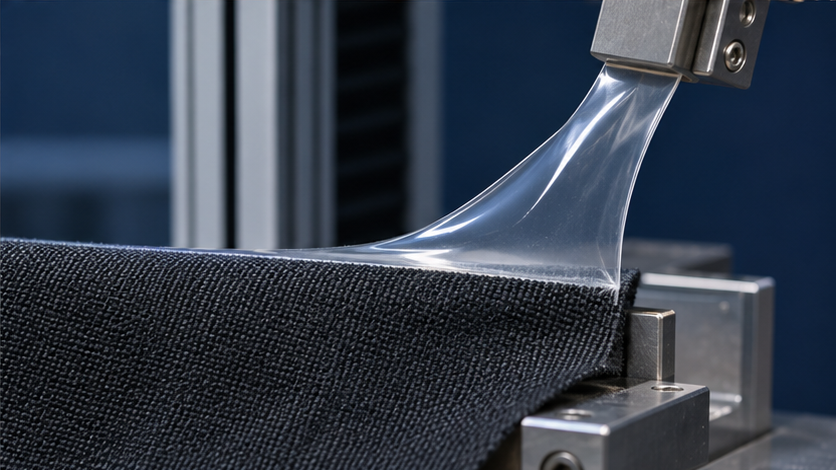
A coated textile can pass peel testing before shipment and delaminate after warm, humid storage. A TPU film may become tacky or tear sooner after a similar exposure. The first step is to locate the failure within the film, coating, adhesive or substrate. This guide focuses on diagnosing the finished construction and qualifying a formulation against that failure.
Where hydrolysis occurs in polyester TPU
The representative bond in the diagram lies in the polyester soft segment. Water-driven ester cleavage creates carboxyl and hydroxyl ends and can undermine mechanical retention. Confirm the soft-segment chemistry with the resin supplier. Check for adhesive failure, migration or moisture-related plasticization when the visible symptom alone is inconclusive.
Figure 1. TPU hydrolysis and carbodiimide stabilization
1. Ester-bond cleavage
P–C(=O)–O–R–P + H₂O → P–COOH + HO–R–P
2. Capture of the carboxyl end group
P–COOH + R¹–N=C=N–R² → O-acylisourea intermediate → N-acylurea adduct
Define a test that reproduces the customer’s failure
Use matched thickness, hardness, drying history and conditioning. For free film, track tensile strength, elongation, tear and surface tack. For coated fabric or laminates, measure peel strength and record whether failure is adhesive or cohesive and in which layer. Include dry-heat exposure where useful to help distinguish the contribution of moisture.
A practical selection guide
| Observed problem | What to check | What to evaluate first |
|---|---|---|
| Free film loses strength after humid exposure | Compare tensile and tear retention against a dry-heat control. | HyMax® grade screening |
| Laminate peels after humid storage | Map the failed interface and test the individual layers. | Stabilize the layer shown to be degrading |
| Dry TPU already shows melt-processing problems | Check pressure, gels and moisture before changing chemistry. | Discuss KL-180 only after TPU compatibility is confirmed |
How to qualify HyMax® and KL-180
Ask for a polyester-TPU HyMax® candidate whose supply form and processing window fit the line. Check appearance, blocking and downstream bonding alongside retained properties. Use KL-180 only as a separate evaluation for a defined melt-processing issue after Langyi reviews the actual TPU system.
Run a dried, additive-free control and a HyMax®-only formulation at supplier-recommended levels. Add a KL-180-only trial where a defined melt-processing issue warrants it. Record resin and additive lots, active content or let-down, drying and processing history. Compare both initial and aged results against a predefined acceptance threshold before deciding whether to try a combination.
Frequently asked questions
Can a humid-ageing test predict a number of service years?
It can compare formulations under the same protocol. A field-life estimate requires a supported relationship between the laboratory exposure and the real service environment.
Can a hydrolysis stabilizer replace resin drying?
Follow the resin supplier’s drying guidance and record moisture at the feed point. An additive trial is easier to interpret when every formulation starts from a comparable moisture history.
Discuss your application with Langyi
Share your resin grade, processing route, target properties and ageing conditions when contacting Hong Kong Langyi. See related applications in Polymers, Films & Coatings.