
An ionic adsorbent for electronic adhesives should be chosen for a defined contamination problem. A high adsorption-capacity figure may be useful, but it does not by itself establish that an additive will work in a particular adhesive, curing process or electronic assembly.
A better selection process connects the target ions with formulation compatibility and a relevant reliability test. The following workflow is intended for teams developing electronic adhesives, including materials considered for flexible printed circuits and other sensitive assemblies.
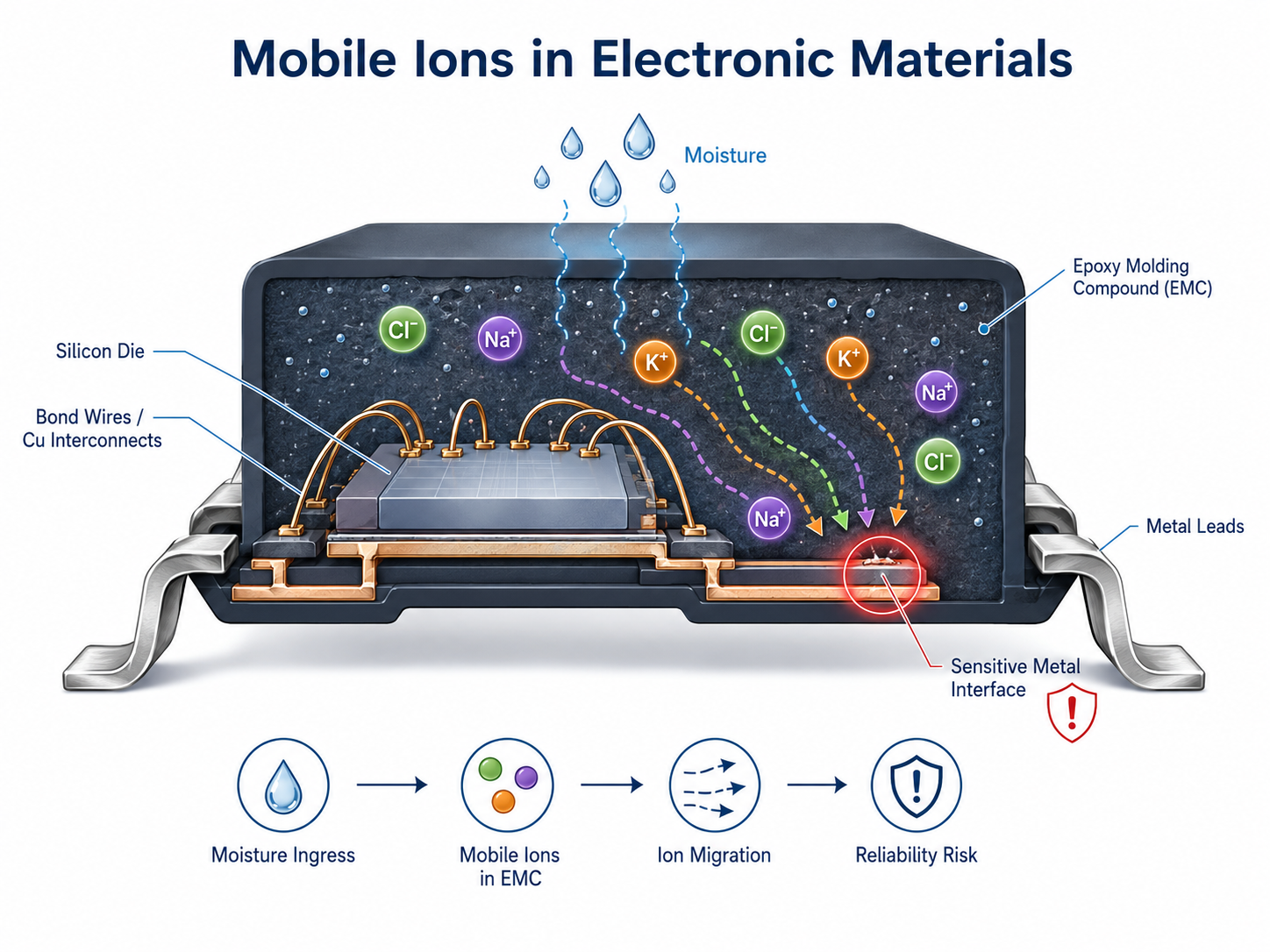
Identify the contamination problem first
Inorganic ion-trapping additives are used to capture impurity ions in electronic materials. LANGYI lists electronic adhesives and FPC materials among the applications for GrabMax® [1]. Other manufacturers also describe inorganic ion capture as a way to improve the reliability of electronic encapsulation materials [2].
Begin by asking what evidence links the observed issue to ionic contamination. Document the failed property, exposure conditions and location of the damage. Record the adhesive formulation and the materials touching it. If the suspected source is uncertain, design the investigation to distinguish adhesive-related contamination from contamination introduced elsewhere in assembly.
Give the laboratory a precise question. “Which extractable ions are present under this method?” is more actionable than “Is this adhesive clean?” Include the sample preparation and extraction conditions with the results so that later comparisons remain meaningful.
Match the exchange type to the target ions
GrabMax® is offered in cation, anion and dual-ion exchange grades [1]. Sodium is a cation, while chloride is an anion. Selecting an exchange type should therefore follow identification of the relevant ionic species, not simply the desire to use the broadest-sounding product description.
Ask the supplier which ions a candidate grade is intended to capture and under what conditions its capacity was measured. Request information on the additive’s own extractable species as well. For a mixed-ion problem, discuss whether a single candidate or a comparison of different approaches is appropriate.
Do not turn a capacity value from a supplier test into a guaranteed removal percentage in the finished adhesive. Use that value to shortlist materials, then evaluate the cured formulation.
Include adhesive processing in the screening plan
Prepare a control and candidate formulations using the same raw-material lots where possible. Follow the proposed addition procedure and record the mixing history. Inspect the mixture for visible nonuniformity and measure the process properties important to the application.
For a dispensing adhesive, this may include viscosity behavior and consistency through the intended equipment. For a coated adhesive layer, assess thickness uniformity and surface appearance. In either case, verify the cured adhesive’s essential function rather than accepting an ionic improvement at the expense of bonding performance.
Set limits for acceptable changes before the test starts. If a candidate requires a different cure schedule or mixing process, record that as part of the proposed material change. The qualification decision should reflect the formulation that will actually be manufactured.
Combine chemical measurements with functional evidence
A useful test sequence separates three questions. First, does the additive change the measured ionic profile under a defined analytical method? Second, does the adhesive retain its required processing and bond performance? Third, does the assembly perform better under the relevant electrical and environmental exposure?
Choose the reliability method with the customer or laboratory according to the actual assembly. Where insulation resistance, leakage or corrosion is relevant, define the electrical conditions, humidity, temperature, geometry and failure threshold. Use the same conditions for control and candidate samples.
Retain analytical blanks and control specimens. Report unsuccessful candidates as well as successful ones, since they help identify tradeoffs. Treat lower extractable-ion measurements as supporting evidence rather than a substitute for a functional reliability result.
Keep the supplier comparison traceable
Create a record for each candidate containing grade name, lot, addition level, calculation basis, mixing procedure, cure schedule and sample dimensions. Attach the current technical information and the laboratory methods used.
For costs, compare the amount required to achieve an acceptable result and any changes to processing. The lowest price per kilogram may not represent the lowest cost per qualified part. This is a purchasing comparison to perform after the technical requirements have been defined.
Explore GrabMax ionic adsorbents and contact LANGYI with your adhesive chemistry, target ions and proposed test conditions to request a candidate grade.
Frequently asked questions
Are all ionic adsorbents interchangeable?
No. Compare exchange type, relevant test conditions and suitability for the adhesive. A shared product category does not establish identical performance.
Should we select only by adsorption capacity?
Use capacity as one input. The evaluation must also address processing, cured properties and the reliability requirement of the assembly.
Does ion trapping eliminate the need for contamination control?
Keep source control in the project plan. Evaluate the additive alongside raw-material selection and assembly cleanliness rather than treating it as a universal correction for contamination.
References
[1] LANGYI GrabMax ionic adsorbents
[2] TOAGOSEI Inorganic ion capture agent IXE technical context