
Introdution
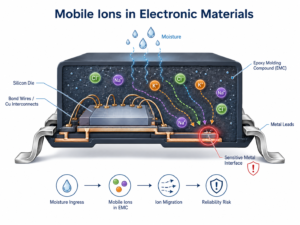
Electronic materials are often evaluated according to properties such as thermal resistance, dielectric performance, mechanical strength and moisture resistance.
But another factor can have a major influence on long-term reliability:
mobile ionic impurities.
Trace ions such as chloride (Cl⁻), sodium (Na⁺), potassium (K⁺) and other ionic species may originate from resins, fillers, additives, synthesis residues, processing equipment or environmental contamination.
Their concentration may be extremely low.
However, when moisture, elevated temperature and electrical bias are present, some of these ions can become mobile and migrate through polymeric materials or along interfaces.
Research on microelectronic encapsulants has shown that epoxy molding compounds can contain ionic contaminants and that absorbed moisture can create conditions under which ionic transport contributes to corrosion. Chloride is particularly important because it can damage protective oxides on aluminum metallization and accelerate corrosion.
This article explains what mobile ions in electronic materials are, where they come from, why they matter to reliability and how technologies such as ionic adsorbents can help control their mobility.
What Are Mobile Ions?
An ion is an atom or molecule carrying an electrical charge.
In electronic-material systems, commonly discussed ionic contaminants include:
- Chloride — Cl⁻
- Sodium — Na⁺
- Potassium — K⁺
- Sulfate — SO₄²⁻
- Bromide and other ionic residues
The important word, however, is mobile.
An ion may be present in a material but strongly bound within a stable chemical structure.
Another ion may be weakly bound, water-soluble or capable of moving through a polymer matrix when moisture is present.
These two situations can create very different reliability risks.
For this reason, engineers should distinguish between:
Total ionic content
and
mobile or extractable ionic species.
The second category is often more closely related to ionic transport under environmental stress.
Where Do Ionic Contaminants Come From?
Electronic materials are complex formulations.
An epoxy molding compound, for example, can contain:
- Epoxy resin
- Silica filler
- Curing agent
- Accelerator
- Coupling agent
- Flame-retardant system
- Pigments
- Release agents
- Other functional additives
Ionic contamination can enter through any of these components.
Epoxy chemistry itself can be one source. Research on microelectronic encapsulants has documented chloride ions associated with epichlorohydrin-based epoxy production.
Other possible sources include:
- Fillers with trace alkali-metal impurities
- Process water
- Catalysts and synthesis residues
- Additives
- Cleaning chemicals
- Manufacturing equipment
- Handling contamination
- External environmental exposure
This means ionic purity should be viewed as a complete supply-chain and formulation-control issue, rather than a property of only one raw material.
Why Moisture Changes the Reliability Risk
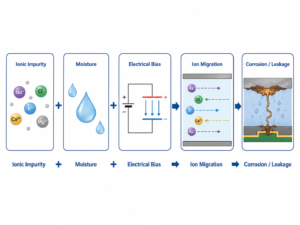
Dry polymer materials generally restrict ion movement.
But many polymeric encapsulants are not completely hermetic.
Moisture can gradually diffuse into the material under humid conditions. A 2022 study of packaging polymers found that ion diffusivity depends strongly on moisture content, salt concentration, pH and temperature.
This creates an important reliability relationship:
Moisture + Mobile Ions + Electrical Bias
↓
Ion Transport
↓
Electrochemical Reactions
When water molecules enter a polymer, soluble ionic species may become more mobile.
If an electrical potential exists between nearby conductors, the electric field can further influence ionic movement.
Therefore, ionic contamination often becomes much more important under:
- High humidity
- High temperature
- Long-term environmental exposure
- Electrical bias
rather than under simple dry-room measurements.
https://langyitechglobal.com/solutions/
What Is Ion Migration?
Ion migration refers to the movement of charged species through a material or across an interface.
In a simplified electronic-material system, the process can be represented as:
Ionic contaminant
↓
Moisture absorption
↓
Ion becomes mobile
↓
Migration toward an electrically or chemically favorable region
↓
Electrochemical reaction
Ion transport in molding compounds is complex.
Studies have shown that ion diffusion can vary significantly according to molding-compound chemistry, moisture conditions, pH, temperature and concentration.
Therefore, there is no single ion-migration rate that applies to every epoxy system.
What Problems Can Mobile Ions Cause?
Metal Corrosion
Chloride contamination is a well-known concern around metallic interfaces.
Research has shown that chloride can attack aluminum metallization, while more recent work continues to identify chloride-containing impurities as a reliability concern around Cu-Al wire-bonded interconnects.
Electrical Leakage
When ionic species move through a moisture-containing environment, they can increase ionic conductivity.
This may contribute to unwanted leakage-current behavior.
Electrochemical Migration
Under suitable moisture and bias conditions, electrochemical reactions may lead to migration or deposition of conductive species.
Insulation Reliability
Ionic contamination can interact with humidity and interface chemistry, reducing the reliability margin of insulating materials.
Long-Term Package Reliability
Modern semiconductor packaging places materials increasingly close to fine conductive structures.
As package geometries become smaller and operating environments become more demanding, controlling moisture and ionic contamination remains relevant to long-term reliability. A recent review of epoxy molding compounds continues to identify moisture-related reliability challenges as an important issue in advanced packaging.
Total Ionic Content vs. Ionic Mobility
A common mistake is to assume:
Lower total ions automatically means lower reliability risk.
In practice, the issue is more complicated.
Consider two hypothetical materials:
| Material | Total Ion Level | Ion Mobility | Potential Concern |
|---|---|---|---|
| Material A | Moderate | Strongly immobilized | Potentially lower mobility |
| Material B | Lower | Highly mobile under moisture | Potentially higher transport risk |
This example does not imply a universal quantitative relationship.
It illustrates a formulation principle:
how strongly an ion is retained can matter in addition to how much ion is present.
This is one reason ion trapping technologies are used in electronic materials.
The goal is not necessarily to make every ionic species disappear.
The goal is to reduce the concentration of ions that remain free to migrate under operating conditions.
How Can Manufacturers Reduce Ionic Contamination?
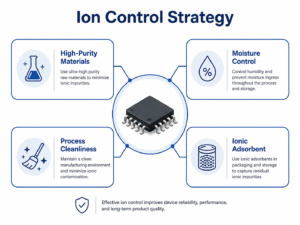
Effective ionic control normally requires several strategies working together.
High-Purity Raw Materials
The first approach is preventing contamination from entering the formulation.
Manufacturers can specify:
- Low ionic impurities
- Controlled chloride
- High-purity fillers
- Qualified water
- Clean synthesis processes
Moisture Control
Reducing moisture absorption makes ion movement more difficult.
Possible approaches include:
- Lower-moisture resin systems
- Improved package design
- Controlled storage
- Proper drying
- Moisture barrier strategies
Process Cleanliness
Even a high-purity formulation can be contaminated during manufacturing.
Process control should therefore include:
- Equipment cleanliness
- Water quality
- Raw-material handling
- Surface cleanliness
- Contamination monitoring
Ionic Adsorbents / Ion Trapping Agents
A fourth strategy is to introduce a functional material designed to bind or immobilize ionic species inside the final material.
Research into electronic encapsulants has documented ion getters that strongly bind chloride ions and retard their diffusion through molding compounds.
This is the basic principle behind an ionic adsorbent or ion trapping agent.
https://langyitechglobal.com/product/ionic-adsorbent/
How Does an Ionic Adsorbent Work?
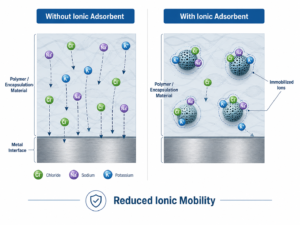
An ionic adsorbent is incorporated into the material system.
Rather than mechanically filtering ions out of an already cured polymer, it provides adsorption, ion-exchange or binding sites capable of interacting with targeted ionic species.
A simplified mechanism is:
Free Mobile Ion
↓
Interaction with Ionic Adsorbent
↓
Captured / Bound Ion
↓
Reduced Ionic Mobility
The key word is:
immobilization.
If an ion is strongly retained by the adsorbent, its ability to migrate toward sensitive metallic interfaces may be reduced.
Hong Kong Langyi’s current electronic-material content positions ionic adsorbents as ion-management materials for high-reliability applications and discusses their use in semiconductor encapsulation systems.
Anion Trapping vs. Cation Trapping
Not all ionic adsorbents work the same way.
Anion Control
Negatively charged ions include:
- Cl⁻
- SO₄²⁻
- Other anionic residues
For semiconductor packaging, chloride is particularly important.
Cation Control
Positively charged ions include:
- Na⁺
- K⁺
- Other metal ions
A material designed to bind chloride does not automatically have the same capacity or selectivity toward sodium.
Therefore, the first question when choosing an ion trapping material should be:
Which ionic species are we trying to control?
Depending on the formulation, an engineer may need:
- Anion trapping
- Cation trapping
- Dual-ion management
Ionic Adsorbent vs. Other Control Strategies
| Strategy | Main Purpose | Key Advantage | Limitation |
|---|---|---|---|
| High-purity raw materials | Reduce incoming contamination | Prevents ions at source | Cannot eliminate every trace impurity |
| Moisture-resistant resin | Reduce water ingress | Limits mobility environment | Does not capture existing ions |
| Process cleanliness | Prevent external contamination | Essential manufacturing control | Requires continuous discipline |
| Ionic adsorbent | Immobilize ionic species | Functions inside final material | Must match target ion and formulation |
| Barrier/package design | Protect package | System-level protection | Depends on package architecture |
The best reliability strategy is therefore usually not:
choose only one.
It is:
Purity + Moisture Control + Clean Processing + Ion Management
Where Are Ionic Adsorbents Used?
Potential electronic-material applications include:
- Epoxy Molding Compound
- Semiconductor Encapsulation Resin
- Underfill
- Electronic Adhesives
- Die-Attach Systems
- High-Purity Polymer Materials
- Automotive Electronic Materials
The exact suitability depends on the chemistry and process requirements of the system.
What Should Engineers Evaluate?
When evaluating an ionic adsorbent, consider:
Target Ion
Is the main concern Cl⁻, Na⁺, K⁺ or another ion?
Adsorption Selectivity
Does the material preferentially interact with the target species?
Performance in the Actual Resin
Adsorption data measured only in water may not predict performance inside a cured epoxy.
Particle Size and Dispersion
An inorganic adsorbent may influence:
- Viscosity
- Flow
- Filler packing
- Surface quality
- Dispersion
Resin Compatibility
The adsorbent must operate without creating unacceptable effects on the curing system.
Reliability Testing
Useful evaluation can include:
- Ion chromatography
- Moisture absorption
- High-temperature/high-humidity testing
- HAST
- Electrical leakage testing
- Corrosion analysis
Optimization should focus on minimum effective loading with acceptable processing and reliability performance, rather than simply maximizing adsorbent concentration.
Conclusion
Mobile ions are a small-scale contamination problem with potentially significant consequences.
Cl⁻, Na⁺, K⁺ and other ionic residues can originate from raw materials, synthesis, additives, manufacturing or the operating environment.
Their reliability impact depends not only on concentration, but also on:
- Moisture
- Temperature
- Electrical bias
- Ion mobility
- Polymer chemistry
- Package architecture
This is why controlling electronic-material reliability requires more than simply measuring total impurity levels.
A complete strategy should combine:
high-purity materials + moisture control + clean processing + management of residual mobile ions.
Ionic adsorbents provide one useful approach by capturing or immobilizing selected ionic species inside the material system.
Looking for an Ionic Adsorbent for Electronic Materials?
Hong Kong Langyi supplies ionic adsorbent solutions for electronic-material applications where mobile ionic impurities may affect long-term reliability.
If you are evaluating an epoxy molding compound, underfill, encapsulant or other electronic polymer system, our technical team can discuss:
- Target ionic species
- Resin chemistry
- Processing conditions
- Particle requirements
- Reliability targets
- Sample evaluation
Contact Hong Kong Langyi to request technical information or discuss an ionic adsorbent for your formulation. https://langyitechglobal.com/contact/
Frequently Asked Questions
What are mobile ions in electronic materials?
Mobile ions are charged species that can move through a material or interface under suitable conditions such as moisture, temperature or electrical bias.
Which ions are commonly monitored?
Common examples include chloride, sodium, potassium and sulfate.
Why is chloride important in semiconductor packaging?
Chloride can attack metallic interfaces and has been associated with corrosion of aluminum metallization and Cu-Al interconnect structures.
What makes ions mobile?
Moisture is an important factor. Ion diffusivity in packaging polymers also depends on temperature, pH, concentration and polymer chemistry.
What is an ionic adsorbent?
It is a functional material designed to bind, capture or immobilize selected ionic species and reduce their mobility.
Is ionic adsorbent the same as ion trapping agent?
The terms Ionic Adsorbent, Ion Trapping Agent and Ion Scavenger are often used for materials performing related ion-management functions, although their exact mechanisms depend on chemistry.
Can one adsorbent trap every ion?
No. Ion selectivity varies between adsorbent chemistries, so target ions should be identified before material selection.
External References
- Lantz, L. & Pecht, M. Ion Transport in Encapsulants Used in Microcircuit Packaging. IEEE Transactions on Components and Packaging Technologies, 2003.
- Herrmann, A. et al. Elucidating the Large Variation in Ion Diffusivity of Microelectronic Packaging Materials. Microelectronics Reliability, 2022.
- Hillman, C., Castillo, B. & Pecht, M. Diffusion and Absorption of Corrosive Gases in Electronic Encapsulants. Microelectronics Reliability, 2003.
- Chopin, S. & Mathew, V. Controlling Extrinsic Chloride Ions Effect on Copper Wirebond Reliability. IMAPS Proceedings, 2019.
- Epoxy Molding Compound Encapsulation Process in IC Packaging: A Review at Wafer and Component Levels. International Journal of Advanced Manufacturing Technology, 2025.