
Introduction
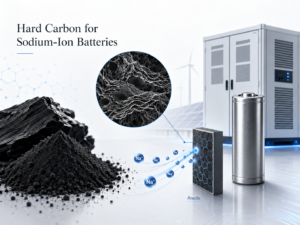
For years, sodium-ion batteries were discussed mainly as a promising alternative to lithium-ion technology.
In 2026, that conversation is changing.
The industry is increasingly moving from laboratory development toward commercial production and GWh-scale deployment.
CATL announced in April that its Naxtra sodium-ion battery had reached GWh-scale industrialization and is scheduled for full-scale mass production by the end of 2026. The company specifically identified hard-carbon gas generation as one of the manufacturing challenges it had to address during scale-up.
In energy storage, commercialization is moving even faster. CATL announced in June that sodium-ion production lines for energy storage were commissioned and operational, with first customer deliveries in China planned for September 2026. The company also disclosed a three-year, 60 GWh sodium-ion energy-storage cooperation agreement with HyperStrong.
These developments bring increasing attention to one material that plays a central role in many sodium-ion battery designs:
hard carbon.
This article explains why hard carbon for sodium-ion batteries has become so important, how it stores sodium and what material parameters manufacturers need to understand as the industry moves toward larger-scale production.
Why Sodium-Ion Batteries Are Gaining Momentum in 2026
Lithium-ion batteries remain the dominant rechargeable battery technology.
But sodium-ion chemistry offers several strategic advantages.
Sodium resources are widely available, and sodium-ion batteries can reduce dependence on lithium-based supply chains.
Their characteristics also make them particularly interesting for:
- Stationary energy storage
- Cold-climate applications
- Selected passenger vehicles
- Commercial vehicles
- Battery-swapping applications
In February 2026, CATL and CHANGAN announced a mass-production passenger vehicle equipped with sodium-ion batteries, with market entry planned for mid-year.
By June, CATL described its sodium-ion energy-storage technology as having reached commercial maturity in technology, production capacity and supply-chain readiness.
The story is therefore no longer simply:
Can sodium-ion batteries work?
The emerging question is:
Can the material supply chain deliver consistent performance at industrial scale?
And that brings hard carbon into focus.
Why Graphite Is Challenging for Sodium Storage
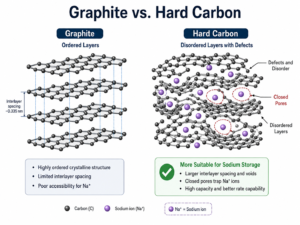
Graphite is the dominant anode material in conventional lithium-ion batteries.
Naturally, researchers initially examined whether the same material could simply be transferred to sodium-ion chemistry.
The answer is not straightforward.
Sodium ions are larger than lithium ions, and conventional graphite does not accommodate sodium through the same highly efficient intercalation mechanism used in common lithium-ion cells.
As a result, researchers have explored alternative anode structures capable of providing:
- Larger interlayer spacing
- Disordered carbon domains
- Defect sites
- Nanopores
- More favorable sodium-storage environments
Among these options, hard carbon has emerged as one of the most practical anode candidates.
A June 2026 Frontiers review describes hard carbon as the most realistic sodium-ion anode candidate because of its combination of cost potential, structural robustness and relatively high reversible sodium-storage capacity.
What Is Hard Carbon?
Hard carbon is a form of non-graphitizable carbon.
Unlike graphite, its carbon layers do not rearrange into a highly ordered graphite structure even after high-temperature treatment.
Instead, hard carbon generally contains a complex microstructure involving:
- Disordered carbon layers
- Turbostratic domains
- Defects
- Open pores
- Closed pores
- Variable surface functional groups
These structural characteristics may appear less ordered than graphite.
But in sodium-ion batteries, that disorder can be useful.
The larger spacing and nanoporous structure can create locations where sodium can be stored.
This makes hard carbon a functional example of how:
less crystalline does not necessarily mean less useful.
For sodium storage, carefully engineered disorder can be an advantage.
How Does Hard Carbon Store Sodium?
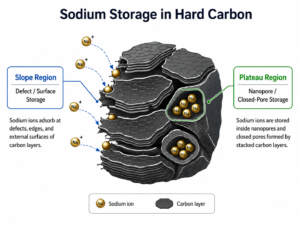
The exact sodium-storage mechanism in hard carbon remains an active research topic.
However, charge-discharge curves are commonly discussed in two broad regions:
a sloping region
and
a low-voltage plateau.
The 2026 Frontiers review connects these regions with different structural features including defects, graphitic nanodomains and nanoconfined pores.
The Sloping Region
At higher potentials, sodium storage is commonly associated with processes involving:
- Defect sites
- Surface sites
- Disordered carbon structures
- Adsorption-related mechanisms
These sites can contribute useful capacity.
However, high exposed surface area can also increase side reactions with the electrolyte.
This becomes particularly important during the first charging cycle.
Low-Voltage Plateau and Pore Storage
At lower potentials, the storage mechanism is increasingly associated with sodium entering or filling nanoscale pore environments.
This region is important because it can contribute significant reversible capacity.
But the objective is not simply:
more pores = better hard carbon.
Pore structure needs to be carefully engineered.
Open surface area can encourage electrolyte decomposition, while suitable closed pore structures may provide sodium-storage sites without exposing excessive reactive surface.
Why Closed Pores Matter
This is one of the most important hard-carbon topics in 2026.
The recent Frontiers review describes hard-carbon design in terms of a “storage-site economy.”
In other words, every structural feature should be evaluated according to two questions:
- How much reversible sodium can it store?
- How much irreversible sodium does it consume?
Closed pores can be useful because they may provide nanoconfined sodium-storage volume while limiting direct electrolyte exposure.
In contrast, excessive exposed surface area may increase formation of the solid-electrolyte interphase, or SEI.
SEI formation consumes sodium.
That creates a major challenge in sodium-ion full cells:
the battery has a limited inventory of active sodium.
If too much sodium is consumed irreversibly during the first cycle, less remains available for useful cycling.
Therefore, hard-carbon development should not focus only on maximizing laboratory capacity.
The more practical objective is:
high reversible storage + high initial efficiency + controlled surface reactivity.
Key Performance Parameters for Hard Carbon
For battery manufacturers, one performance number is rarely enough.
Several characteristics need to be evaluated together.
Reversible Capacity
This indicates how much sodium can be stored and recovered during cycling.
Higher capacity is generally desirable, but it must be evaluated together with efficiency and durability.
Initial Coulombic Efficiency — ICE
ICE compares the sodium recovered from the first charge-discharge process with the sodium inserted.
Low ICE means more sodium is consumed irreversibly during initial cycling.
This can significantly affect full-cell energy performance.
Pore Structure
Important parameters can include:
- Closed pores
- Open pores
- Micropore distribution
- Nanoconfined volume
Pore structure influences both storage capacity and electrolyte interaction.
Specific Surface Area
A high surface area can provide more active sites.
But excessive exposed surface may also increase parasitic reactions and SEI formation.
Particle Size and Distribution
Particle characteristics influence:
- Electrode coating
- Packing density
- Rate performance
- Processability
Tap Density / Electrode Density
Battery performance is not determined only by gravimetric capacity.
Volumetric performance also matters in practical cell design.
Purity
Trace metallic or inorganic impurities can affect electrochemical consistency and battery reliability.
Moisture Control
Hard-carbon manufacturing and electrode processing can be sensitive to moisture.
CATL specifically identified extreme moisture control and hard-carbon gas generation among the engineering bottlenecks that had to be solved during sodium-ion scale-up.
Hard Carbon vs. Graphite
| Property | Graphite | Hard Carbon |
|---|---|---|
| Structure | Highly ordered | Disordered / turbostratic |
| Typical role | Mainstream Li-ion anode | Leading Na-ion anode candidate |
| Sodium storage suitability | Limited in conventional carbonate systems | More favorable |
| Interlayer structure | Highly regular | Larger/disordered spacing possible |
| Pore contribution | Limited | Important |
| Surface engineering | Important | Critical |
| First-cycle efficiency | Mature Li-ion performance | Major optimization target |
| Manufacturing maturity | Very high | Rapidly scaling |
The comparison shows why hard carbon should not simply be viewed as:
“less ordered graphite.”
It is a different material platform requiring different structural optimization.
What Challenges Remain Before Large-Scale Adoption?
Initial Coulombic Efficiency
Irreversible sodium consumption remains one of the most important challenges.
Possible solutions under investigation include:
- Surface engineering
- Pore optimization
- Pre-sodiation
- Electrolyte optimization
Material Consistency
As production moves from laboratory kilograms toward industrial tonnes, maintaining consistent:
- Pore structure
- Particle size
- Carbonization
- Surface chemistry
- Purity
becomes increasingly difficult.
Gas Generation
Industrial battery manufacturers must manage interactions between hard-carbon surfaces and electrolyte chemistry.
CATL has specifically identified hard-carbon gas generation as a mass-production challenge addressed during the development of its Naxtra sodium-ion system.
Cost
Hard carbon must ultimately compete not only technically, but economically.
Industrial scale, precursor selection and carbonization efficiency will influence final cost.
What 2026 Market Developments Mean for Hard Carbon Suppliers
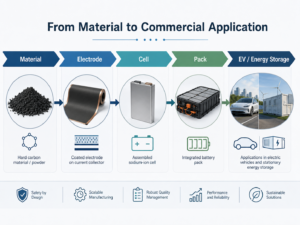
Current market signals show that hard carbon is moving from an emerging R&D material toward a more industrialized product category.
According to Shanghai Metals Market, China’s hard-carbon anode production in July 2026 increased 101% year-on-year, while capacity utilization among mainstream producers was approaching its ceiling. SMM also reported structural tightness in high-end hard-carbon products.
This is important for materials suppliers because rapid volume growth creates a new challenge:
quality consistency.
At low volume, customers may tolerate extensive sample screening.
At GWh scale, manufacturers need:
- Lot-to-lot consistency
- Controlled pore characteristics
- Stable particle distribution
- Reliable purity
- Reproducible electrochemical behavior
- Scalable supply
The competitive question therefore moves from:
Can you make hard carbon?
to:
Can you manufacture the same hard carbon consistently at scale?
The Sodium-Ion Supply Chain Is Becoming Commercial
Several developments in 2026 illustrate this transition.
CATL has announced:
- A sodium-ion passenger-vehicle program with CHANGAN
- GWh-scale Naxtra industrialization
- A 60 GWh sodium-ion energy-storage cooperation with HyperStrong
- Commissioned sodium-ion energy-storage production lines and planned customer deliveries
These announcements do not mean sodium-ion batteries will immediately replace lithium-ion technology.
The more realistic view is that the two chemistries will coexist and serve different performance and cost requirements.
That still represents a major opportunity for hard-carbon development.
Shanghai Langyi’s Advanced Carbon-Silicon Materials Portfolio
Shanghai Langyi Functional Materials currently lists Hard Carbon, Porous Carbon and Silicon-Carbon within its official Advanced Carbon-Silicon-Based Functional Materials platform. Its website also identifies lithium batteries as one of the company’s major application sectors.
For overseas customers, Hong Kong Langyi can act as an international interface for discussing advanced-material requirements and coordinating technical or supply conversations.
It is important, however, to match any hard-carbon material to the customer’s actual battery chemistry and qualification requirements.
For sodium-ion applications, manufacturers should define requirements such as:
- Target capacity
- ICE
- Particle size
- Surface area
- Pore structure
- Tap density
- Moisture
- Purity
- Electrode-processing requirements
before completing material selection.
Conclusion
Sodium-ion batteries are entering a new phase in 2026.
Commercial vehicle programs, stationary energy-storage projects, GWh-scale supply agreements and new manufacturing capacity are moving the technology closer to industrial deployment.
At the center of that transition is hard carbon.
Hard carbon provides structural characteristics that make sodium storage more practical than conventional graphite, including disordered carbon domains and nanoscale pore environments.
But commercial success depends on more than maximizing capacity.
Future hard-carbon materials need to balance:
Reversible Capacity + Initial Coulombic Efficiency + Closed-Pore Storage + Surface Stability + Density + Processability + Cost + Manufacturing Consistency
As sodium-ion batteries move toward larger-scale deployment, the ability to control these properties consistently may become one of the most important competitive factors in the anode-material supply chain.
Exploring Hard Carbon and Advanced Carbon Materials?
Shanghai Langyi’s current advanced carbon-silicon materials portfolio includes hard carbon, porous carbon and silicon-carbon materials. https://www.langyitech.com/index.html
If your company is developing battery or advanced-energy materials, Hong Kong Langyi can help coordinate discussions around:
- Application requirements
- Technical specifications
- Sample evaluation
- Material qualification
- China manufacturing and supply resources
Contact Hong Kong Langyi to discuss your hard-carbon or advanced carbon-material requirements.
Frequently Asked Questions
Why is hard carbon used in sodium-ion batteries?
Its disordered carbon structure, enlarged local interlayer spacing and nanoscale pores provide more suitable sodium-storage environments than conventional graphite.
Is hard carbon the same as graphite?
No. Graphite is highly ordered and graphitizable. Hard carbon remains largely disordered even after high-temperature treatment.
What is the most important hard-carbon property?
There is no single parameter. Capacity, initial Coulombic efficiency, pore structure, surface area, density, particle size, purity and cycle performance must be evaluated together.
Why are closed pores important?
Suitable closed pores can contribute reversible low-voltage sodium storage while limiting excessive direct electrolyte exposure.
Why is initial Coulombic efficiency important?
Low first-cycle efficiency consumes part of the available sodium inventory and can reduce practical full-cell capacity.
Are sodium-ion batteries already in mass production?
The industry is moving into large-scale commercialization in 2026. CATL reports GWh-scale sodium-ion industrialization, commissioned energy-storage production lines and full-scale Naxtra production targeted by the end of 2026.
Does Shanghai Langyi offer hard carbon?
Shanghai Langyi’s current official product center lists hard carbon among its Advanced Carbon-Silicon-Based Functional Materials.
External References
- CATL. Naxtra Sodium-ion Battery: Achieving GWh-scale Sodium-ion Industrialisation. April 2026.
- CATL. TENER Sodium Energy Storage System. June 2026.
- CATL & HyperStrong. 60 GWh Sodium-Ion Energy Storage Cooperation Agreement. 2026.
- Wu, H. et al. Hard Carbon Anodes for Sodium-Ion Batteries: Balancing Closed-Pore Storage, Surface Reactivity, and Sodium Inventory. Frontiers in Materials, June 2026.
- Shanghai Metals Market. China Sodium-Ion Battery Market — July 2026 Hard Carbon Market Update. August 2026.
- Shanghai Langyi Functional Materials. Advanced Carbon-Silicon-Based Functional Materials.