
Infrared blocking additive testing becomes useful when it helps a team make a reproducible production decision. A promising laboratory sample is a starting point, but manufacturers also need to know how consistently a coating or extrusion process can deliver the required optical properties.
After choosing a suitable additive format, the next step is a controlled trial. This guide proposes a practical evaluation workflow for transparent films, coatings and polymer sheets, from defining the comparison basis to reviewing pilot-production samples.
Define the finished product before comparing additives
Start with the construction that the customer will actually use. Record the base polymer or coating resin, substrate, intended thickness and any layers added later. Establish the required visible transmission, appearance and infrared measurement before ordering samples.
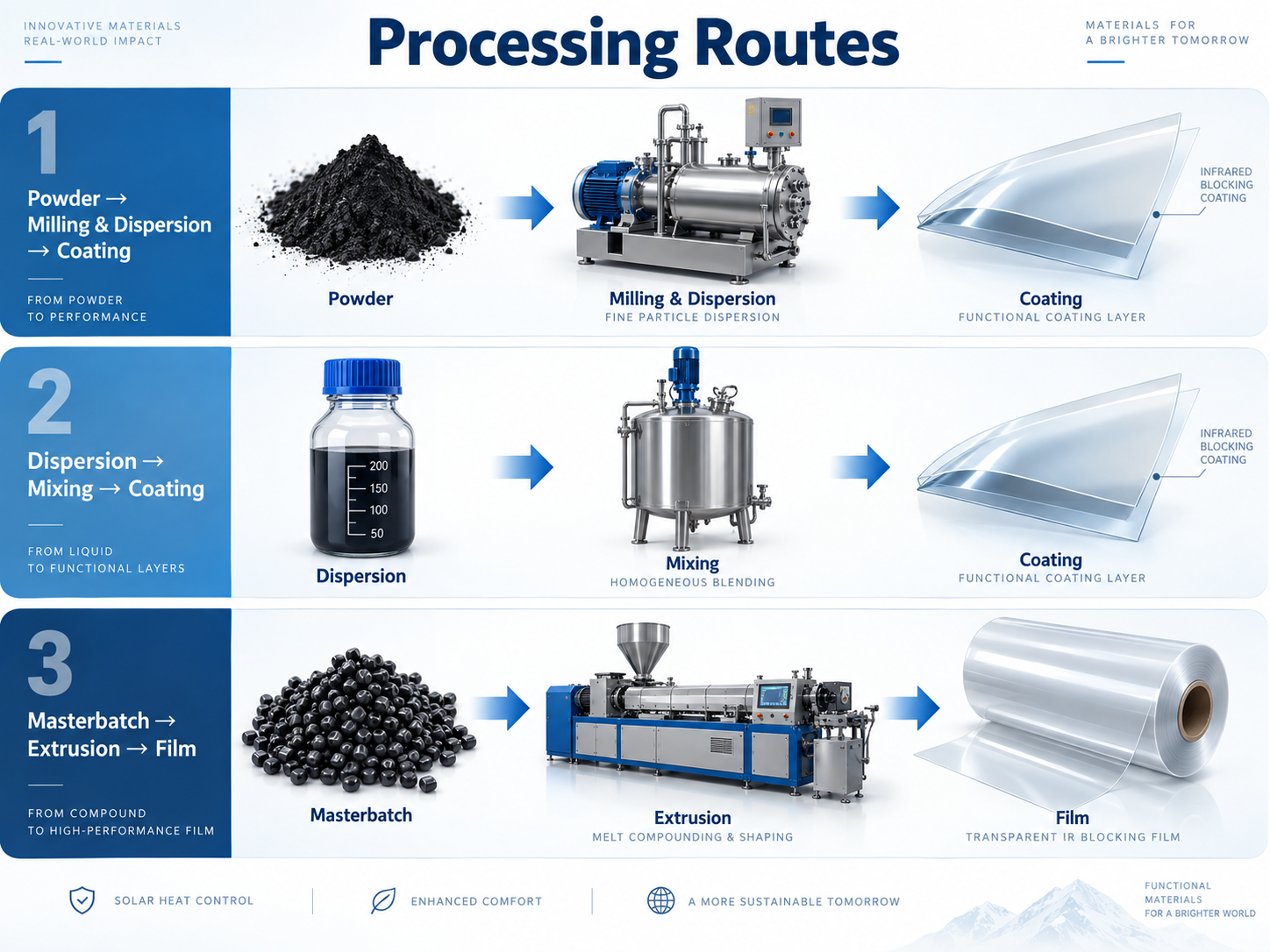
LANGYI’s AntibariMax® portfolio includes powder, solvent dispersion and polymer masterbatch formats [1]. Their suitability should be discussed in relation to the chosen processing route. Once a candidate format is identified, qualify it in the intended formulation rather than treating its supply-form description as proof of finished-product performance.
Choose a clear comparison basis
Before preparing samples, decide what the first experiment is intended to compare. Equal active loading can help compare formulations under a common addition basis. A separate comparison at matched visible transmission can help assess whether a candidate meets the project’s optical balance. These are different experiments and should be reported separately.
For a dispersion or masterbatch, obtain the active content from the relevant grade information. Equal amounts of two supplied products do not necessarily introduce equal amounts of active material. Record both the supplied-product addition and the calculated active loading.
Keep a control without the infrared additive. Where practical and appropriate, include a control accounting for the carrier or liquid introduced by the candidate. Discuss the control design with the supplier so that the trial addresses the intended question.
Record the variables that determine whether the trial can be repeated
| Trial record | Coating route | Extrusion route |
|---|---|---|
| Base material | Resin grade, solids and liquid medium | Polymer grade and drying history |
| Addition basis | Supplied dispersion and active content | Masterbatch ratio and active content |
| Processing | Mixing order, application and drying | Feeding, throughput and melt conditions |
| Finished sample | Substrate and dry coating thickness | Sheet or film thickness and sampling position |
| Evaluation | Optical method, conditioning, appearance and agreed acceptance limits | |
Change a limited number of variables at each stage. If loading, thickness and preparation method all change together, the team may struggle to identify why one sample looks better. A smaller, interpretable experiment is a stronger basis for a second trial.
Build a coating trial around the intended holding and drying conditions
Prepare the complete coating formulation using a documented mixing sequence. Inspect it immediately after preparation and after the planned holding period. Record application behavior and any visible nonuniformity before assessing the finished film.
Make samples on the intended substrate and measure the dry coating thickness. Use the drying schedule available on the proposed production line. If a laboratory sample needs a longer or hotter schedule, identify that difference in the report rather than assuming the same result will transfer directly.
Retain samples from repeated preparations. This gives the team a way to distinguish a reproducible formulation from a single successful drawdown.
Build an extrusion trial around consistent feeding and sampling
For an extrusion trial, confirm the masterbatch carrier, handling recommendations and addition basis with the supplier. Use the intended base-resin grade and record the drying and feeding procedure.
Collect specimens at defined points during the run and, where relevant, across the film or sheet width. Record thickness with each optical result. Inspect visible defects and color uniformity alongside the numerical measurements.
Document any adjustments made during production. If the operator changes throughput or another process setting, identify which samples were produced before and after the change. This preserves the relationship between process conditions and measured performance.
Interpret infrared results together with visible appearance
LANGYI’s architectural-film guidance explains that infrared attenuation should be evaluated with visible transmission, haze, color and the final glazing configuration. Absorbed energy can heat the coating or glass, so reduced infrared transmission is not equivalent to all of that energy being reflected outdoors [2].
Ask the laboratory to state the wavelength range and method behind each reported infrared figure. Compare samples on the same basis. For a glazing application, include the intended glass-and-film construction rather than relying only on an isolated coating measurement.
A simple heat-lamp demonstration may help illustrate a difference under its own conditions, but it should not be presented as a universal estimate of building energy savings. Keep the claimed outcome aligned with what was measured.
Use a qualification record to decide the next step
Bring processing observations, optical measurements and acceptance limits into one record. Identify which candidates pass, which need another trial and which fail an essential requirement. Include repeat samples rather than reporting only the best result.
When discussing scale-up with LANGYI, share the resin or polymer grade, sample construction, addition basis, processing record and test method. Review AntibariMax infrared blocking agents and contact the technical team to discuss the next evaluation.
Frequently asked questions
Should every comparison use the same additive percentage?
State what the percentage represents. Equal supplied-product additions may contain different active amounts. Choose the comparison basis around the experiment’s purpose.
Why measure thickness for each sample?
Thickness is part of the sample definition. Recording it helps the team judge whether optical measurements represent comparable constructions.
When is a laboratory result ready for production approval?
Use the project’s qualification criteria. A practical decision should include repeatability, the intended process and the required finished-product properties, not just one favorable optical reading.
References
[1] LANGYI AntibariMax infrared blocking agent formats
[2] LANGYI Selective Solar Management for Architectural Window Films